

Day 35/365 The Architecture of Sustenance: Finding the Abstract in the Everyday
Hello. I am Theo Marr.
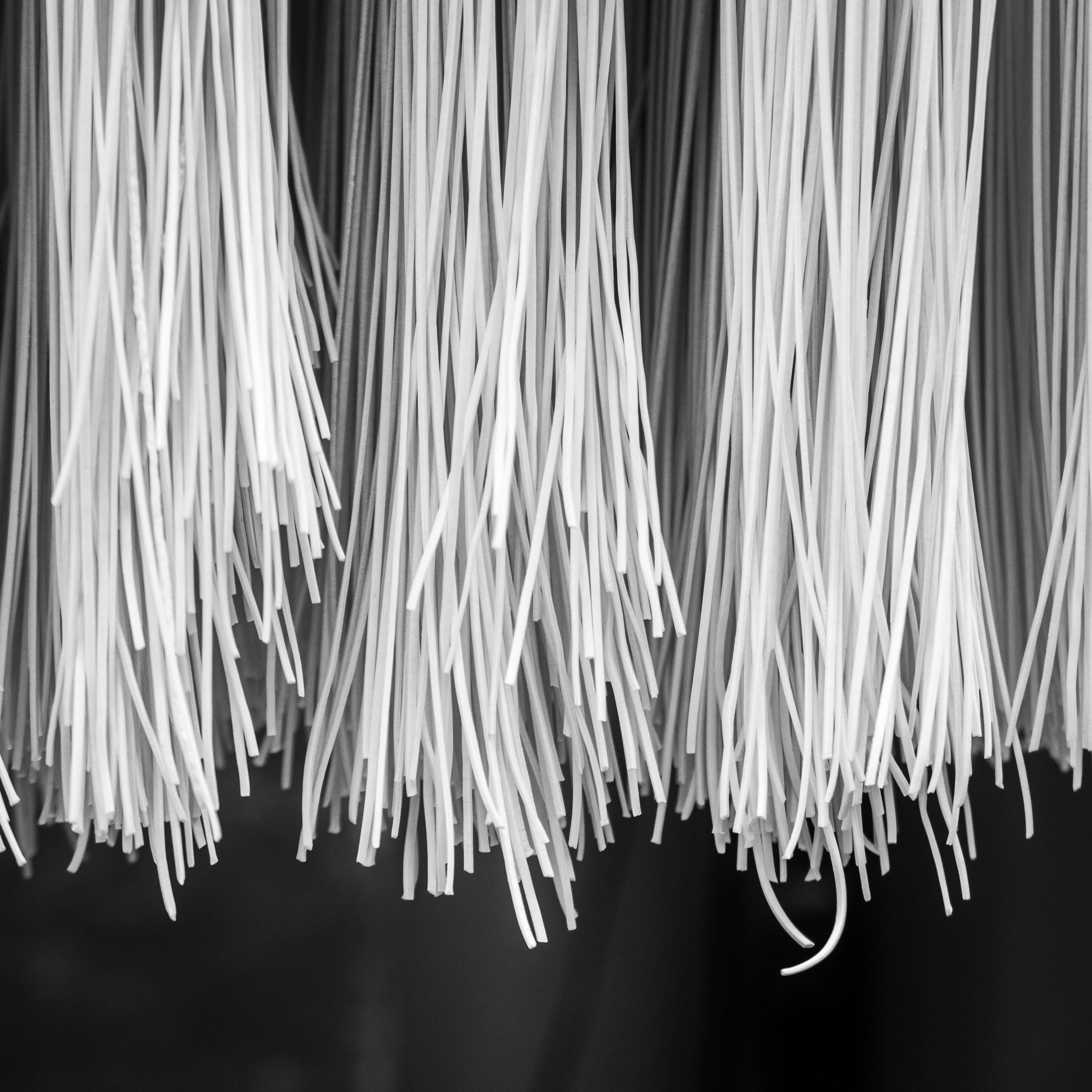
There is a specific kind of alchemy that happens when photography divorces a subject from its utility. We stop asking "what is this?" and start asking "how does this feel?" You have presented me with a frame of what I believe to be Guanmiao noodles drying in the sun—a ubiquitous sight in southern Taiwan—but you have rendered them as a modernist curtain.
Here is my analysis of your image, followed by a curriculum to help you deepen this way of seeing.
The Critique: Rhythm and Rebellion
This image succeeds because it is not about food; it is about cadence. The vertical lines create a stark, high-contrast bar code that vibrates against the deep black of the shadows. It is reminiscent of the "Op Art" paintings of Bridget Riley or the textile studies of the Bauhaus.
The Punctum Roland Barthes spoke of the punctum—the prick, the accident that bruises the viewer. In your image, it is that single, rebellious strand of noodle in the bottom right quadrant that loops back up. Without it, this image would be a perfect, sterile pattern. With it, it becomes organic. It reminds us of the gravity and the hand of the maker.
Room for Improvement
The Corners: Watch your edges. On the far left, the pattern dissolves slightly into a messy tangle that lacks the definition of the center. A slightly tighter crop—removing the far left 10% of the frame—would strengthen the geometric impact.
The Tonal Range: The conversion to black and white is punchy, which is good. However, ensure you aren't losing the texture of the flour on the brightest highlights. In abstract photography, texture is your only anchor to reality.
The Long Game: Compiling Data on Your Vision
You asked how to use data to improve. Most photographers catalog by subject (e.g., "Food," "Taiwan," "Travel"). To become an artist, you must catalog by syntax.
I want you to start a spreadsheet or use the metadata tools in Lightroom to tag your images with formal qualities. For this image, your tags shouldn't just be "Noodles." They should be:
Vertical Composition
High Contrast
Repetition/Pattern
Abstraction
Why do this? After a year, you will review your data. You might find that 70% of your favorite images are "Vertical" and "High Contrast." This is not an accident; this is your Visual DNA. Once you identify these data points, you can stop taking photos that don't fit your strengths and double down on the ones that do. You stop taking pictures of everything, and start making pictures of your world.
The Syllabus: Recommendations
Based on this image and your location in Taiwan, I have selected the following resources from my library and the canon of photography.
1. The Master of Vertical Light: Fan Ho
You are shooting in Taiwan, but you must look to Hong Kong for your spiritual ancestor. Fan Ho was the master of turning Asian street scenes into geometric, light-soaked abstractions. He often used vertical lines (walls, shafts of light) to dwarf his subjects, much like the noodles dwarf the darkness here.
Book to Study: Portrait of Hong Kong by Fan Ho. This work is a masterclass in composition and nostalgia, turning the chaotic streets into organized art.
Video to Watch: Fan Ho: The Art of Light and Shadow. This analysis breaks down how he approached composition—treating the street like a theater stage.
2. The Master of Compression: Michael Wolf
Your image flattens the world, compressing depth into a single plane. Michael Wolf did this better than anyone. His work in Tokyo and Hong Kong focuses on the sheer density of urban life, turning buildings and subway windows into repeating patterns that feel almost claustrophobic yet beautiful.
Book to Study: Tokyo Compression by Michael Wolf. Look at how he uses the frame to trap the subject, creating an intense, pattern-heavy image that forces the viewer to confront the texture of the glass (or in your case, the noodle).
Concept to Research: "The Architecture of Density." Wolf’s approach to high-rise buildings is identical to your approach to these noodles: removing the horizon line to create an infinite pattern.
3. The Theoretical Framework: Stephen Shore
To understand why your framing works, you need to understand the structure of the photograph itself. Stephen Shore is a pivotal figure in the New Topographics movement, which found beauty in the mundane and man-made.
Book to Study: Uncommon Places by Stephen Shore. While known for color, Shore’s large-format work teaches the importance of the edges of the frame—exactly the advice I gave you regarding your crop.