

Day 360/365 A Sharp Boat in a Moving World: Panning the Qijin Ferry
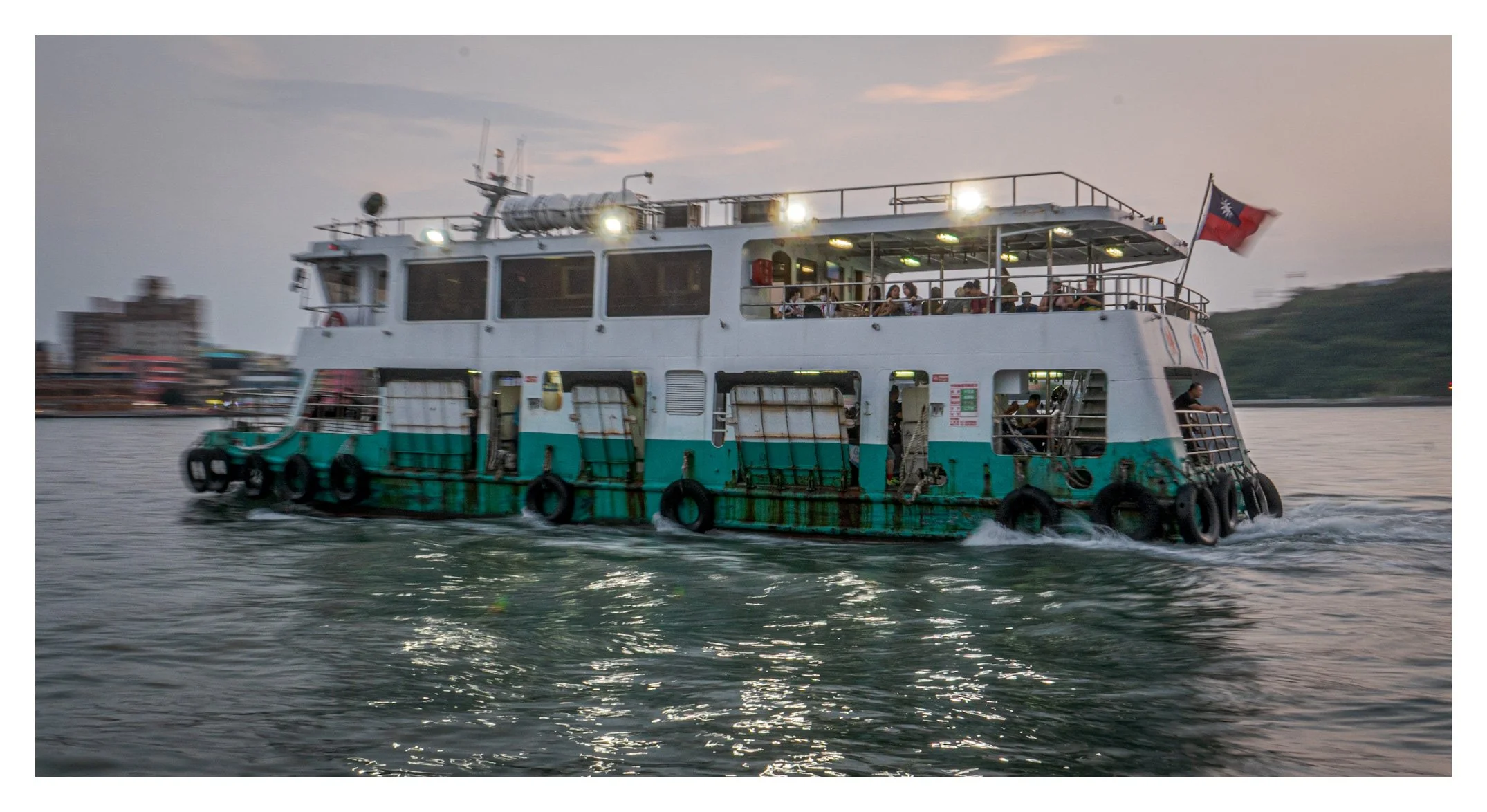
At 1/8 of a second, the Qijin ferry holds its detail while the harbour streaks past. Theo Marr looks at how this dusk panning shot works, where the blur helps and where it hurts, and how to turn one good crossing into a repeatable technique.
Metadata
Camera Model: Leica D-Lux 8
Shutter Speed: 1/8 sec
Aperture: f/14
ISO: 200
Also recorded: 15mm on the DC Vario-Summilux 10.9-34mm f/1.7-2.8 lens, 16 October 2026, 17:31, DNG, cropped from 4736 x 3552 to 4736 x 2480 (1.91:1)
Critique
This is the most ambitious use of the shutter in the series so far. A weathered ferry crosses the harbour at dusk, its white upper deck lit and lined with passengers, its teal hull streaked with rust and hung with old tyres as fenders. The ferry holds a good amount of detail, while the green headland on the right, the buildings on the left, the flag and the water all streak into motion. At 1/8 sec, that is a real panning shot, and it is the slowest shutter speed you have used in nineteen frames.
The strengths are clear.
The panning works where it matters. The hull, the tyres, the rust runs, the doors and the passengers along the rail are readable, so the eye has a sharp subject to land on. The blur is doing the job of showing speed, and the red and blue flag smearing at the stern is a lovely small piece of evidence that the ferry is moving.
The colour is well chosen. A teal and rust hull against a pink and mauve dusk sky is a natural complementary pairing. The lit deck, with warm lamps along the rail, gives the picture a human glow.
The deck lamps have turned into small starbursts, which is a bonus of f/14. They add sparkle without taking over.
The water is a bonus too. The glittering trails in the lower half echo the motion of the boat, and they give the picture a calm, textured foreground.
The weaknesses are about control.
The sharpness is partial. The middle of the hull is the crispest part, while the bow and the stern soften. This is normal when a boat turns slightly as you pan, but it means the bow tyres and the stern are not as clean as the centre.
The stern merges with the headland on the right. The dark opening at the back of the ferry sits against the dark green hill, so the end of the boat loses its edge exactly where the eye leaves the picture.
The ferry is moving left, but the frame gives it little room to move into. There is about as much space ahead of the bow as behind the stern. A little more room ahead would make it feel like it is going somewhere.
The processing looks a touch heavy. The local contrast in the hull and the water is crunchy, and the shadows look lifted, which brings out grain in the dark areas.
f/14 is a deliberate choice to get the slow shutter in the dusk light. The price is a little diffraction softness on the small sensor.
Improvement
• Shoot a series. A crossing is short, so use several: 1/8, 1/15 and 1/30 sec, ten frames each, and keep a note of which frames are sharpest.
• Pan with your body. Turn from the hips, keep your elbows tucked, and keep moving the camera after the shutter closes.
• Leave room ahead. Frame so that there is more water in front of the bow than behind the stern.
• Watch the background behind the stern. A lighter patch of sky or water there would give the end of the boat an edge.
• Try f/8 to f/11 if the light allows a shutter speed of 1/15 or so. You should gain a little more crispness than at f/14.
• Ease the processing. Pull back the clarity and lift the shadows less, and let the dusk colour carry the picture.
• Trim a little from the bottom if you want a tighter frame. Around 8 percent would make the picture more compact without losing the glitter.
• Come back at the same time on a different day. Dusk light, a lit deck and a steady supply of ferries make this a good place to practise.
Growth and Data
Nineteen images in nineteen consecutive days.
• Shutter: the range is now 1/8 to 1/2000 sec. This is your slowest frame, and your first deliberate motion-blur frame.
• Aperture: eleven frames at f/2.8 or wider and eight between f/3.2 and f/14. f/14 is your narrowest so far.
• ISO: the range is 32 to 640. ISO 200 accounts for nine of nineteen frames. The ISO ceiling test above 640 is still owed.
• Cameras: eleven frames on the Leica D-Lux 8, five on the Ricoh GR III, two on the iPhone 17 and one on the Fujifilm X-Pro2.
• Crop: eighteen of nineteen frames are cropped. Eight are squares, five are 4:5, five are widescreen and one is uncropped. This crop keeps 70 percent of the sensor.
• Light: two of your recent frames (Posts 14 and 19) were shot at dusk, and both show your best colour work. You seem to like transitional light.
• Subject: this is your first harbour and ferry frame, a new theme for the series.
Next steps
• Make panning a project: one location, one time of day, a shutter speed ladder.
• Use the dusk light to run the ISO test above 640, with a stationary subject first.
• Check the edges of the subject against the background before you shoot.
• Keep the daily habit going.
Photographers to Study
• Alfred Stieglitz: made The Steerage on an ocean liner in 1907, a picture of passengers on separate decks that is also a study of shapes, and the nearest classic to your layered ferry.
• Alexey Titarenko: a long-exposure street photographer whose City of Shadows turned the crowds of St Petersburg into ghostly streaks, and a master of blur as meaning.
• Allan Sekula: photographed harbours and the work of ships in Fish Story, and treated the sea as a working place.
• Hiroshi Hamaya: Japan's first Magnum photographer, who documented people and their relationship with the sea and the land along the Sea of Japan coast.
• Kikuji Kawada: a Japanese photographer of symbolic, shadowy pictures, who has spoken of images made by light and speed.
Books to Read
• The Steerage and Alfred Stieglitz, Jason Francisco and Anne McCauley
• The City Is a Novel, Alexey Titarenko
• Fish Story, Allan Sekula
• Japan's Back Coast (Ura Nihon), Hiroshi Hamaya
• Chizu (The Map), Kikuji Kawada
Videos to Watch
• Alfred Stieglitz, The Steerage (Smarthistory, with a video conversation on the page): https://smarthistory.org/stieglitz-the-steerage/
• The Forgotten Space, trailer, by Allan Sekula and Noel Burch: http://www.theforgottenspace.net/static/trailer.html
• Alexey Titarenko, audio interview (Lens Culture): https://www.lensculture.com/articles/alexey-titarenko-alexey-titarenko
• Kikuji Kawada, 92 Year Old Who Still Uploads to Instagram Daily After 60+ Years of Photography: https://www.youtube.com/watch?v=6Szwce5QMrQ
• Panning Photography: How to Blur the Background without Blurring the Subject (Maggie Hudson, Photography Hacker): https://picturecorrect.com/?p=40243
Manufacturer Note
For Leica Camera Taiwan and Leica Camera Japan: eleven of the nineteen frames in this daily series were made on the D-Lux 8, including this slow-shutter ferry frame at 15mm, 1/8 sec and f/14. A pocketable zoom that can hold a moving subject against a streaked harbour, turn deck lamps into small starbursts and keep detail in the DNG at ISO 200 is a story I would like to tell with Leica. I would welcome a conversation about a partnership.