

Day 37/365 Asphalt & Reflections: Finding the Cinema in a Rainy Kaohsiung Crossing
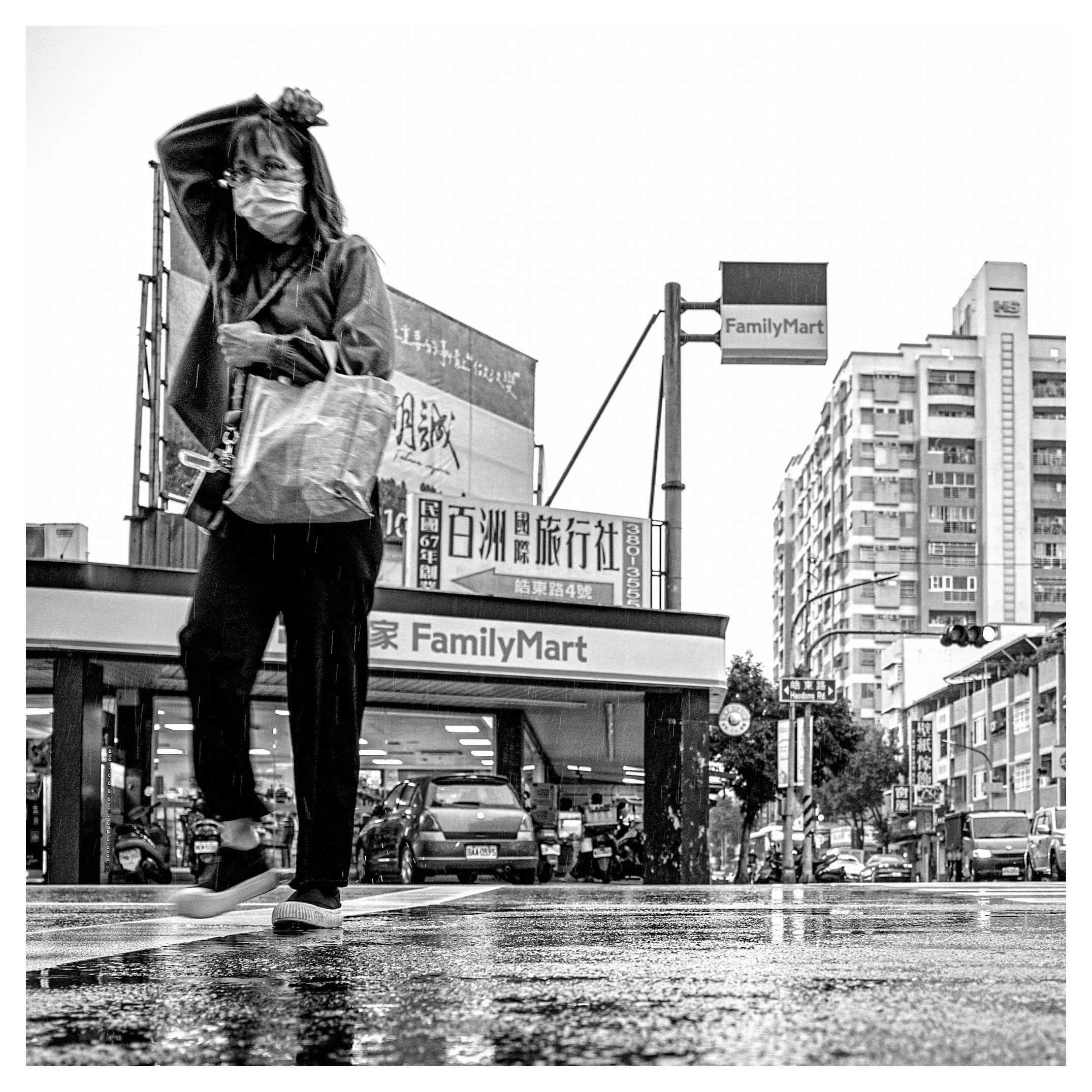
The Critique: A Worm’s Eye View of the Mundane
There is a visceral quality to this image that immediately grabs the viewer. By placing the camera on the pavement—a technique often called the "worm's eye view"—you have elevated a mundane moment of commuting into something monumental. The wet asphalt ceases to be a road and becomes a stage, reflecting the chaos of the city back at the subject.
What is working:
* The Gesture: The subject’s hand, raised to shield against the rain (or perhaps the wind), is the "punctum" of this image—the emotional hook. It suggests struggle and resilience.
* The Perspective: The low angle makes the subject loom large, giving them a heroic stature against the towering architecture.
* The Tones: The high-contrast black and white edit suits the mood perfectly. The deep blacks in the trousers anchor the image, while the reflections on the ground provide necessary texture.
Where to improve:
* Background Separation: This is the eternal struggle of street photography. The subject's head, particularly the face, intersects with the dark mass of the billboard in the background. In a perfect world, a half-step to the right or waiting for the subject to move forward would have placed her head against the lighter sky, creating a cleaner silhouette.
* Signage Dominance: The "FamilyMart" sign is structurally heavy. In urban Taiwan, these signs are ubiquitous, but here, the sharp geometry and text compete with the organic shape of the woman.
* Highlight Management: The sky is a "paper white" washout. While common in overcast weather, bringing back just a fraction of detail (if the raw file allows) or burning the edges slightly could force the eye back down to the subject more effectively.
Actionable Advice: The Art of "Working the Scene"
To improve this specific type of shot in the future, I recommend "fishing" rather than "hunting."
When you find a location with such excellent reflections and architecture:
* Set your frame first. crouch down and compose the background so that there is a "clean" patch of sky or light wall where you expect a head to appear.
* Wait. Let the subjects walk into your trap. This allows you to guarantee that the background won't clutter the portrait.
* Underexpose slightly. In digital black and white, it is easier to recover shadows than blown-out highlights. Protect your sky.
Becoming a Better Photographer: The "Data" Approach
You mentioned compiling data. This is a brilliant strategy used by disciplined artists to escape their plateaus. You should not just track what you shoot, but what you keep.
I suggest creating a "Metalog" (a metadata log) for your best 50 images of the year. Track these three metrics:
* Focal Length: Are 90% of your best shots at 28mm? If so, stop carrying the 85mm.
* Aperture: Are you consistently shooting at f/8 for depth, or f/2 for isolation?
* Failure Cause: For every "almost" good shot, log why it failed. (e.g., "Missed Focus," "Bad Background," "Too Slow").
Over time, this data will reveal your subconscious style. You might realize you are actually an architectural photographer trying to force yourself to be a candid portraitist, or vice versa.
Theo’s Curriculum: Resources for Study
To refine your high-contrast, gritty aesthetic, you must study the masters of the "Provoke" era and those who followed.
1. The Master of Grit: Daido Moriyama
Your image has the seeds of the Are-Bure-Boke (grainy, blurry, out-of-focus) style famous in Japan.
* Read: Farewell Photography or A Hunter by Daido Moriyama. Look for his use of "grit" and "high contrast" to convey the feeling of the city rather than just its look.
* Watch: Artist Daido Moriyama – In Pictures | Tate. This video provides a rare glimpse into how he walks the streets—he is like a stray dog, moving constantly.
2. The Master of Light: Trent Parke
Parke is an Australian Magnum photographer who pushes contrast to the breaking point.
* Read: Minutes to Midnight. This monograph is a masterclass in "dreamlike" documentary and "high contrast" work. Study how he uses light to separate subjects from chaotic backgrounds.
* Watch: The Secret of Trent Parke's Street Photography. This breaks down how he waits for the light to transform ordinary moments.
3. The Outsider's Eye: Robert Frank
Since you are shooting in Taiwan (perhaps as an expat or local, but capturing the "scene"), look at how Frank captured America.
* Read: The Americans. Focus on his "road trip" aesthetic and the "outsider" perspective. It will teach you about sequencing images to tell a story about a country.