

Day 38/365 The Paused Frame: Finding Stillness in Taiwan’s Urban Cha
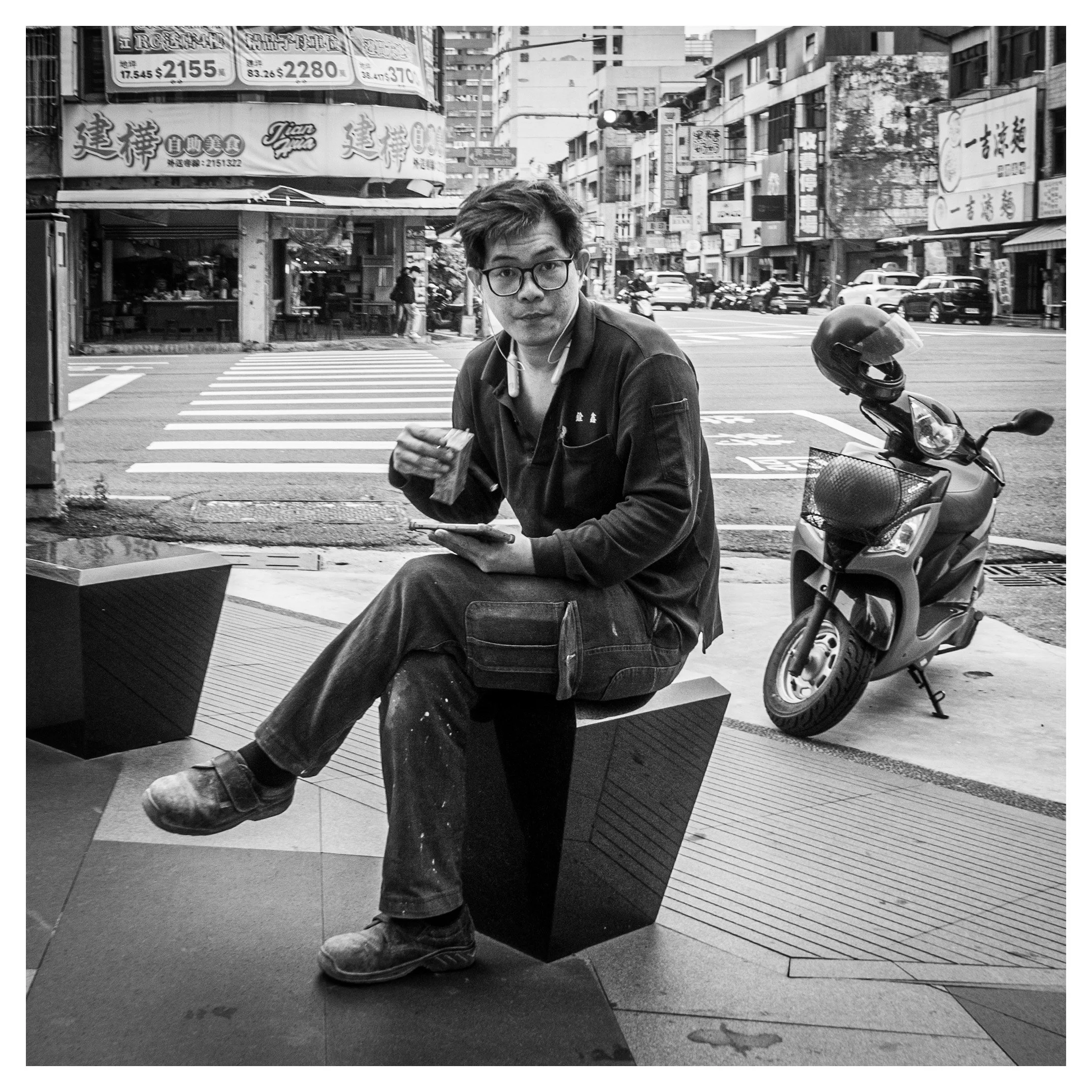
There is a specific humidity to the air in Taiwan that seems to soften the light, even on overcast days. It acts as a giant softbox, wrapping around subjects on street corners. In today’s critique, we are looking at a black and white street portrait that captures a moment of respite: a worker, likely taking a break, perched on a geometric stone bench in Kaohsiung.
The image has a strong "bones"—a direct gaze and a clear anchor—but like many street photographs, it fights a war against the chaos of the urban environment. Let us dissect the image to see how we can win that war in the future.
The Critique: Separation and Geometry
The Strengths
The immediate strength of this image is the juxtaposition. You have a subject dressed in the rough, practical attire of manual labor (boots, heavy shirt) seated on a polished, modern geometric bench. This contrast between the organic, gritty texture of the worker and the sharp, architectural lines of the seat is excellent. It tells a story of the city: the people who build it versus the structures they build.
The eye contact is also vital. The subject is engaging with you. He is not passive; he is challenging the lens. This creates a psychological connection that pulls the viewer in.
The Areas for Improvement
However, the image suffers from a classic street photography ailment: background merger.
1. Heads and Signs: Look closely at the subject’s head. The signboard in the background (the text and the vertical lines of the building) appears to be growing directly out of his skull. In black and white, where color doesn't help separate planes, tonal overlap can be fatal. The dark hair blends into the dark details of the building behind him.
2. Depth of Field: The background is nearly as sharp as the subject. This "flatness" makes the image feel busy. A wider aperture (lower f-number) would have blurred that busy intersection, making the subject pop in 3D relief.
3. Angle of View: A slightly lower angle—getting your knees dirty—would have pushed his head up against the brighter sky or the cleaner part of the building, instantly solving the separation issue.
The Method: The Spreadsheet of Light
You asked how to compile data to improve. Most photographers obsess over technical data (shutter speed, ISO), but artistic data is where growth happens.
To become a better photographer, you must treat your practice like a scientific study. I recommend creating a simple database—a "Ledger of Light"—with the following columns for every significant shoot:
• The Technical: Focal Length, Aperture, Shutter.
• The Intent: Why did I stop? (e.g., "The contrast," "The face," "The geometry").
• The Result: Did I achieve it? (Yes/No).
• The Failure Point: If "No," why? (e.g., "Background too busy," "Missed focus," "Bad light").
• The Emotional Tone: (e.g., "Alienation," "Joy," "Solitude").
Over a year, you will see patterns. You might realize, “I consistently fail when shooting wide angles in busy markets because I don't get close enough.” That data is your roadmap to mastery.
The Curriculum: Who to Study
Based on your current work and your database of books, here is where you should focus your attention next.
1. The Typologies: August Sander
Your image reminds me of the work of August Sander. He didn't just take pictures of people; he categorized society by their trade. He photographed the baker, the bricklayer, and the revolutionist with equal dignity.
• Why study him: To learn how to pose subjects so their "uniform" and their "tools" tell the story for you.
2. The Taiwanese Master: Chien-Chi Chang
You have his work in your database, and for good reason. His series "The Chain" is a masterclass in environmental portraiture.
• Why study him: Chang is a Magnum photographer who understands the psychological weight of a subject. Note how he uses the environment to trap or liberate his subjects.
3. The Poet of the Street: Fan Ho
Another name from your library, Fan Ho’s "Portrait of Hong Kong" is essential.
• Why study him: Fan Ho was a master of simplifying the chaotic Chinese street. He used harsh lighting and shadows to "hide" the background clutter—exactly what your current image needs.
4. The Outsider: Robert Frank
You listed "The Americans" in your records. Frank shot from the hip, often with a grittiness that felt unpolished but emotionally raw.
• Why study him: For the courage to embrace the "imperfect" composition if the feeling is right.
Recommended Viewing
To visualize these concepts, watch these specific breakdowns:
• Sean Tucker: “Protect your Highlights (and your shadows)” – This will teach you how to use high contrast (like Fan Ho) to hide your background.
• The Art of Photography (Ted Forbes): “The History of Street Photography” – A great primer on the lineage from Sander to Frank.
• Magnum Photos: “Course Trailers” – Even the free trailers for their courses offer incredible insight into the mindset of photographers like Chien-Chi Chang.