

Day 39/365 The Phantom Frame: Shooting Through the Velocity of Urban Life
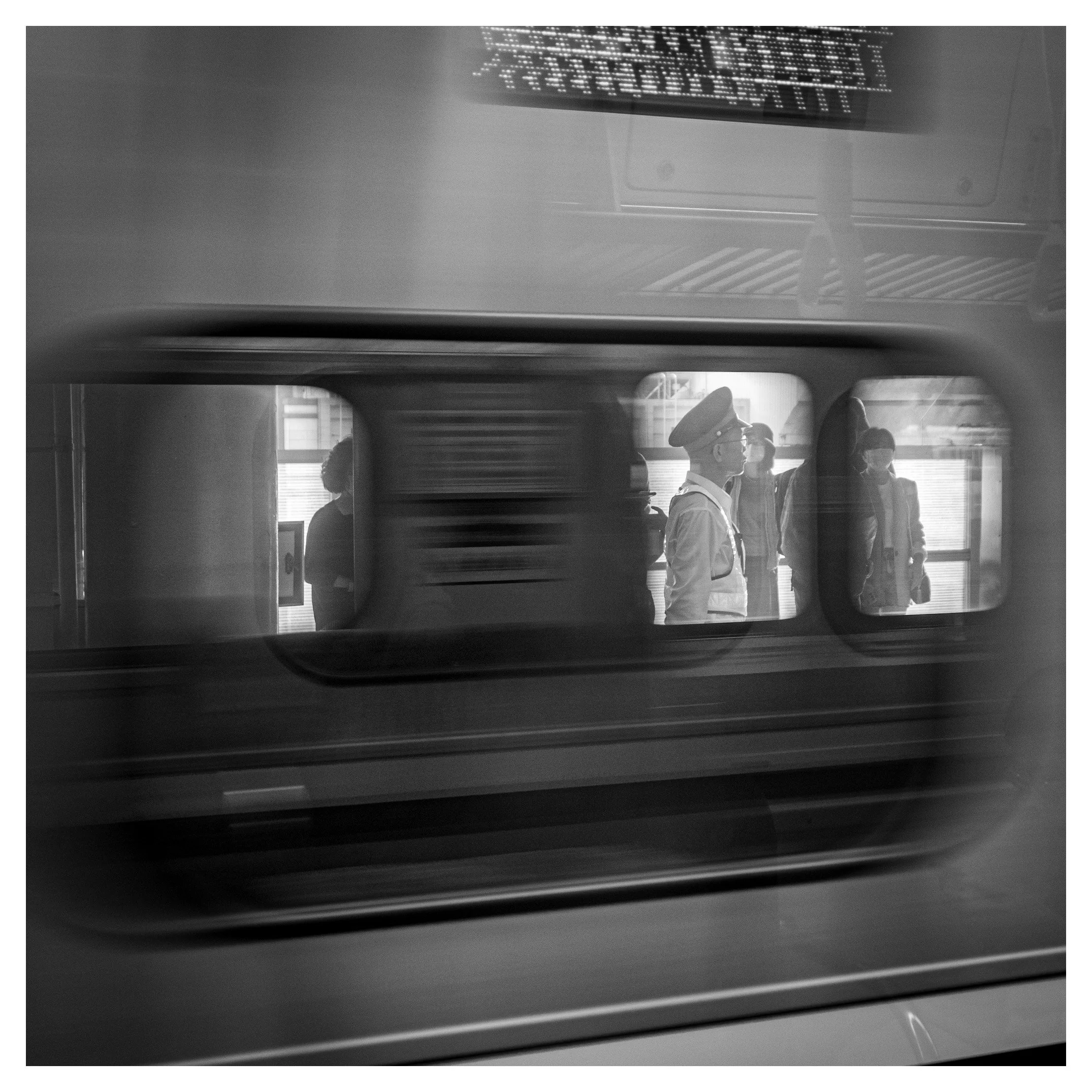
The Critique: The Art of Interruption
This context changes everything. Knowing that you were stationary and shooting through a moving train to capture a stationary subject on the far side elevates this from a "lucky snap" to a high-difficulty exercise in timing and layering.
The Complexity of the Layers
You are essentially dealing with three planes of reality:
* Your Plane: The stationary interior you are sitting in (visible in the subtle reflections and the dark vignette).
* The Interruption: The moving train on the middle track. This is your "shutter within a shutter." It obscures 90% of the world, leaving only a fleeting window of visibility.
* The Subject: The conductor on the far platform.
Why It Works
The moving train acts as a natural matte. In cinema, we use mattes to block out parts of the frame to focus attention. Here, the city provided the matte for you. The motion blur of the passing train contrasts beautifully with the static stoicism of the conductor. He looks like an officer inspecting the chaos, untouched by it.
The Critique & Improvements
* The "Slit-Scan" Timing: Because you are shooting through a moving window, your timing must be microscopic. In this frame, the "window" of the moving train is slightly misaligned with the conductor—he is pushed to the right side of the opening.
* The Fix: Zone Focusing. In this situation, autofocus will fail—it will try to latch onto the moving train. Pre-focus on the far platform (or use manual focus peaking) and shoot in a high-speed burst. You are trying to catch the exact millisecond the moving window creates a perfect center frame for the subject.
* Refining the Crop: My previous advice stands even stronger here. The bottom of the frame (likely the door of the moving train) is heavy and dark. A cinematic 16:9 crop will emphasize the horizontal speed of the passing train and reduce the dead space at the bottom.
The Data Approach: Tracking "The Obstruction"
To master this specific style—complex layering—you need to track how you handle obstructions. Add these columns to your photo log:
* The Layer Count: How many barriers are between you and the subject? (e.g., 1 = Just air, 2 = Window, 3 = Window + Moving Object). You will likely find that your "Keeper Rate" drops drastically at "Layer 3," but the impact of the successful shots is higher.
* The Shutter Sync: Log the shutter speed relative to the moving object. Did 1/60th blur the train enough to make it abstract, or did it leave distracting details? You are looking for the "Goldilocks" speed—slow enough to blur the obstruction, fast enough to freeze the subject.
The Library: Resources for Study
Your image relies on looking through things. You are finding order in chaos by using the environment to frame the subject. Here are new recommendations from your database and beyond that specialize in this "voyeuristic" style.
1. Photographers to Research
* Saul Leiter: The absolute pioneer of shooting through condensation, windows, and urban obstructions. He viewed the city as a series of fragments. He often obscured 80% of his frame to show only a sliver of color or a face.
* Alex Webb: A Magnum photographer known for complex, multi-layered compositions. He fills every plane of the image (foreground, middle ground, background) with information.
2. Books to Read (From Your Database)
* "Early Color" by Saul Leiter: This is the bible of "shooting through stuff." [cite_start]Study how Leiter uses window frames, not as annoyances, but as compositional devices to divide the image.
* "The Suffering of Light" by Alex Webb: Webb’s work will teach you about "The Layer Count." [cite_start]Look at how he manages to keep a subject sharp even when shooting through fencing, glass, or crowds.
* "The Americans" by Robert Frank: Specifically, look at his "Trolley - New Orleans" image. [cite_start]It is the spiritual ancestor of your photo—using the windows of a transport vehicle to frame portraits of society.
3. Videos to Watch
* The Art of Composition with Saul Leiter: A look at how Leiter composed his images using the "obscured view."
* Watch: Saul Leiter - In No Great Hurry (Trailer & Clips)
* Alex Webb: The Suffering of Light: Listen to Webb describe how he waits for the layers to align. He talks about the "gift" of street photography—when the world arranges itself for you.
* Watch: Alex Webb on The Suffering of Light