

Day 40/365 The Shark in the Stands: Finding the Surreal in the Everyday
A Critique by Theo Marr
Photography is often mistakenly defined as the art of seeing. I argue it is the art of organizing. When you look at a baseball game in Taiwan, the eye is assaulted by stimulus: colors, cheers, movement, spilled beer. The camera’s job is to slice a rectangle out of that chaos and impose order.
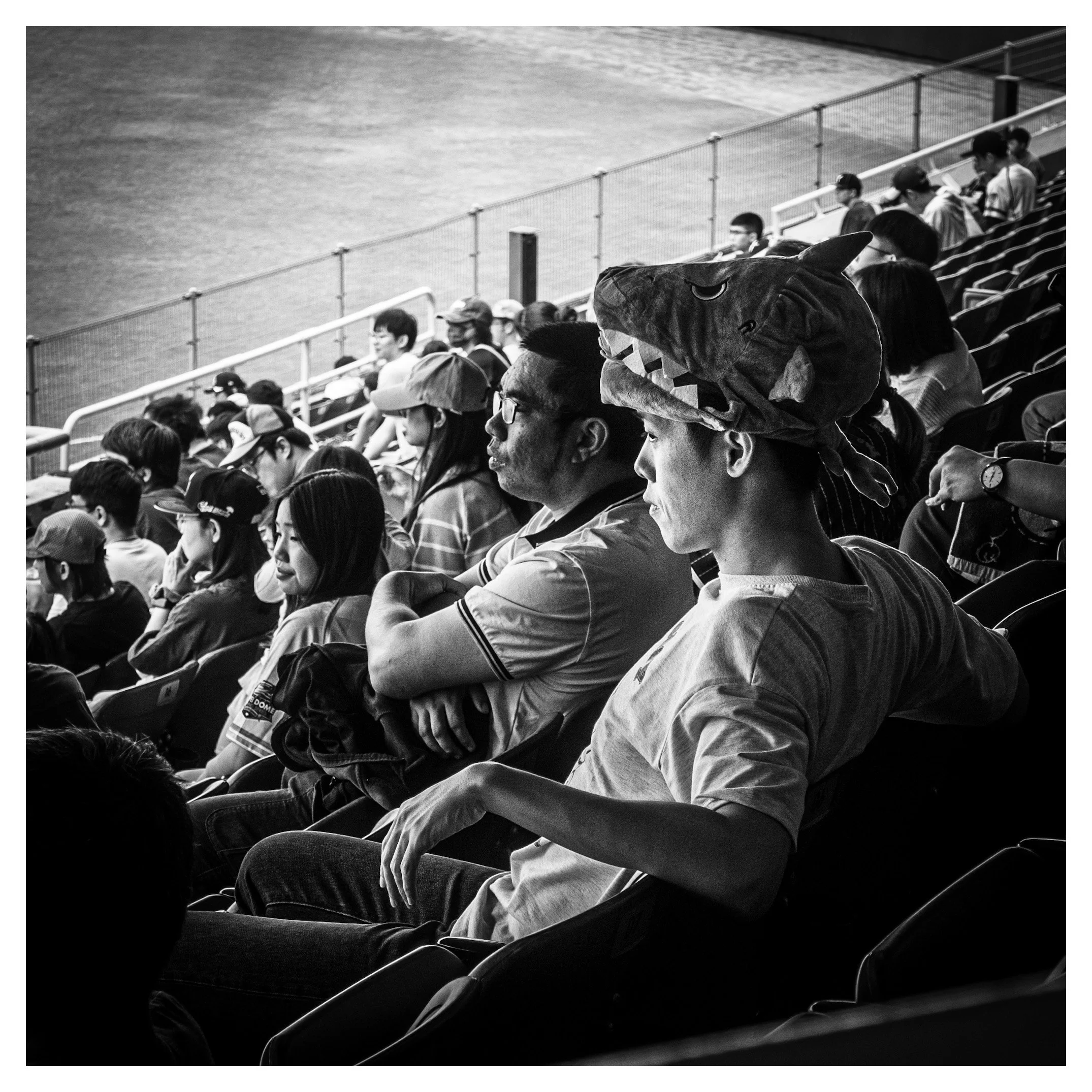
In this image, you have succeeded in finding the punctum—that piercing detail that Roland Barthes famously described as the element that "pricks" the viewer. Here, it is the plush shark headgear worn by the young man. It is a moment of delightful absurdity. The subject is surrounded by the crowd, yet he feels entirely alone, gazing off-frame with a stoic expression that contradicts the playfulness of his hat.
The Strengths:
• Tonal Range: You have chosen black and white, which was the correct decision. Color would have distracted us with the likely garish hues of stadium seats and team jerseys. The monochrome forces us to look at the texture of the plush hat and the light hitting the subject’s cheek.
• Geometry: The diagonal lines of the stadium seating and the railing create a strong structural rhythm that leads the eye from right to left.
The Weaknesses:
• Background Distraction: The man directly behind your subject (wearing glasses) is problematic. His face is too sharp and too bright, competing for our attention. In a "crowd" shot, you want the crowd to be a texture, not a collection of competing portraits.
• Framing: The composition sits comfortably in the middle distance. It feels safe. A slight step closer, or a longer focal length, would have compressed the background further and isolated the "Shark Man" more dramatically.
Immediate Advice for This Image
1. The "Dodge and Burn" Technique
You need to guide the viewer’s eye more aggressively. In your post-processing software (Lightroom/Capture One), use a brush to slightly darken (burn) the face of the man in the glasses behind the subject. Conversely, slightly brighten (dodge) the side of the Shark Man's face. This creates a hierarchy of light that tells the viewer exactly where to look.
2. The Crop
Consider a tighter crop. If you remove the empty space on the far left and the dead space at the bottom right, you increase the tension. Make the Shark Man the undeniable king of the frame.
Becoming a Better Photographer: The Metadata Journal
You asked how to compile data to improve over time. Most photographers rely on "feeling," but the masters rely on analysis. I recommend you start a Metadata Journal.
Create a spreadsheet with the following columns for every significant shoot:
1. Technical: Focal Length, Aperture, Shutter Speed.
2. Context: Location, Time of Day, Weather.
3. Intent: What were you trying to capture? (e.g., "The energy of the crowd").
4. Result: What did you capture? (e.g., "A quiet moment of isolation").
5. The "Keep Rate": How many shots did you take vs. how many were usable?
Why do this?
After six months, review the data. You might find that your best images happen at 35mm, not 50mm. You might discover you are terrible at capturing "energy" but brilliant at capturing "isolation." This data prevents you from fighting your natural style and helps you lean into your strengths.
Recommendations for Further Study
To understand how to photograph crowds and the surreal nature of modern life, you must study those who mastered the chaotic frame.
Photographers to Research
• Chien-Chi Chang: A Magnum photographer born in Taiwan. His work often deals with alienation and the bonds between people. Look at his series The Chain, which features environmental portraiture and explores mental asylum patients connected by chains. It is a masterclass in repetition and human connection, relevant to how you organize bodies in a stadium.
• Michael Wolf: Specifically his book Tokyo Compression. He photographed commuters pressed against subway windows. It teaches you how to frame claustrophobia and isolation within a crowd.
• Garry Winogrand: The master of "chaotic" street photography. His book Figments from the Real World will teach you how to use a wide-angle lens to include more of the scene without losing the subject.
• Martin Parr: For the humor. Your image has a touch of Parr’s satire—finding the ridiculous (the shark hat) in the mundane. His book The Last Resort is essential for understanding color and social documentary, though the lessons on composition apply to B&W as well.
Videos to Watch
• The Street Philosophy of Garry Winogrand: An excellent breakdown of how Winogrand used "tilt" and energy in his frames.
• Martin Parr’s Advice to Young Photographers: Parr discusses finding your personal connection to the world—essential for finding more "Shark Men" in the wild.
• The Street Photography of Joel Meyerowitz: Meyerowitz is a master of color, but his philosophy on "the pause" and anticipation is universal.