

Day 75/365 The Architecture of Light: Seeing the Unseen
EXIF Info
Camera Model: Fujifilm X-Pro2
Shutter Speed: 1/240
Aperture: f/5.6
ISO: 200
The Critique
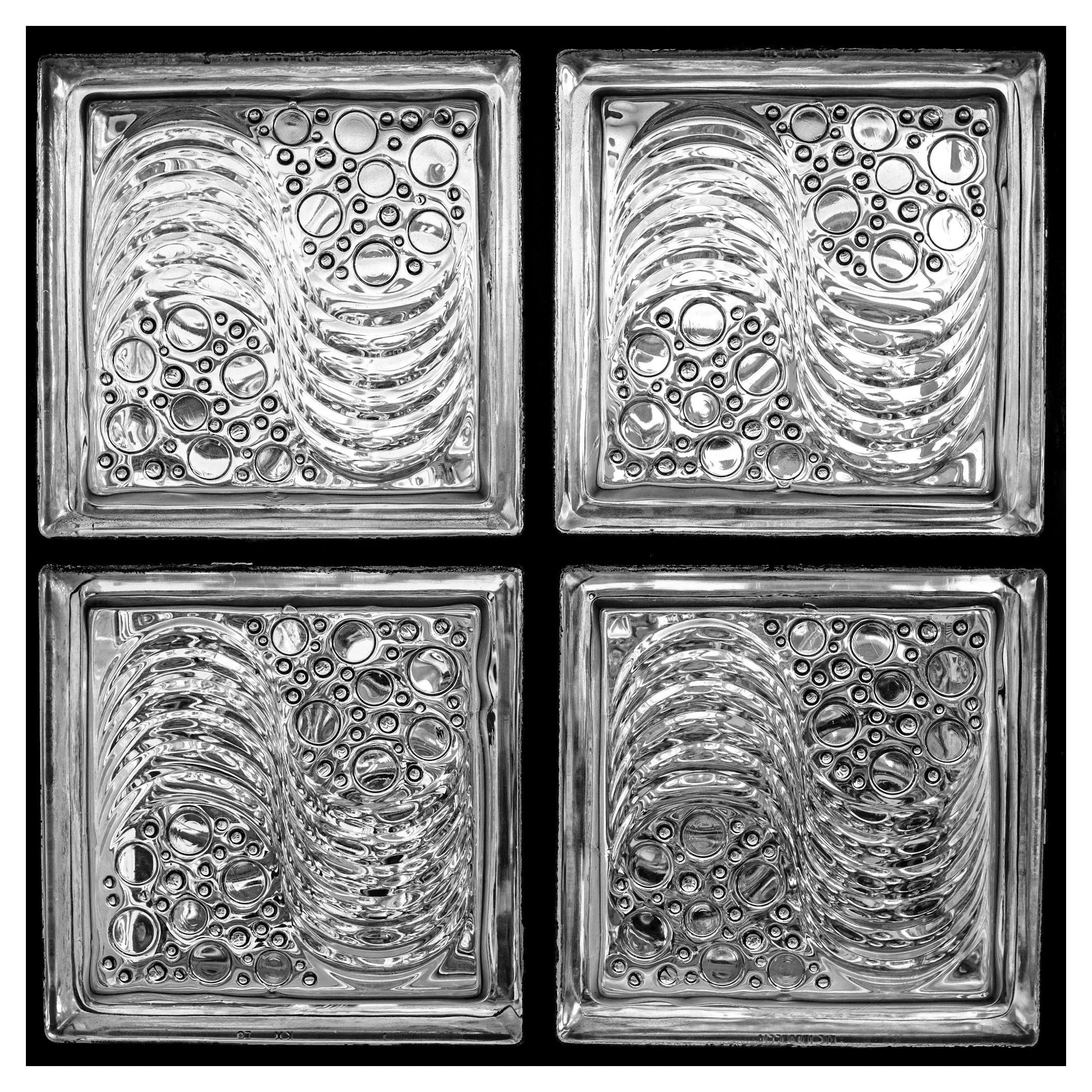
This image is a delightful exercise in visual rhythm. By isolating these four glass blocks, you have removed the context of the building—we do not know if this is a factory, a shower, or a subway station—and forced the viewer to engage purely with form and texture. It is a choice that aligns you with the modernist tradition of "seeing," where the subject matter is secondary to the graphic impact of the image.
The decision to present this in monochrome was the correct one. Color would likely have introduced temperature distractions (the green tint of cheap glass or the warmth of indoor tungsten) that would detract from the study of refraction. Here, the blacks are deep and the highlights crisp, creating a metallic, almost liquid quality to the glass swirls. The repetition of the circular "bubble" motifs against the wave-like ridges creates a satisfying internal tension—a balance between order (the grid) and chaos (the organic swirls).
However, the image feels slightly constrained. The framing is tight—perhaps too tight. The tension at the edges is palpable; we are right up against the bezel of the frame. While this claustrophobia can be effective (emphasizing the "wall" nature of the subject), it also risks feeling like a technical crop rather than a compositional choice. A fraction more negative space around the perimeter, or conversely, a much tighter crop into a single block, might have made the intent clearer.
Improving the Image
To elevate this specific image, I would suggest a slight adjustment to the contrast curve in the mid-tones. The "whites" of the glass are bright, but there is a murky quality in the mid-greys that could be lifted to make the glass feel more translucent and less like polished steel.
Furthermore, look closely at your symmetry. The vertical gap between the blocks is not perfectly centered, nor is it perfectly vertical. In geometric abstraction, precision is your currency. If you are going to present a grid, the geometry must be impeccable, or the deviation must be intentional and obvious. Use the "Guided Transform" or "Upright" tools in your post-processing software to ensure those lines are mathematically straight.
The Photographer's Log: Compiling Data for Growth
You asked how to improve over time by compiling data. Most photographers rely on the EXIF data (shutter, aperture, ISO) automatically stored by the camera. While useful, this is merely distinct technical data. It tells you how the image was made, but not why.
To become a better photographer, you must record the "invisible data." I recommend keeping a physical or digital logbook where you record the following for your best shoots:
• The Intent: What were you trying to say? Did you want to show the hardness of the glass or the softness of the light?
• The Mood: Was the environment chaotic? Were you rushing? This helps you understand if you shoot better under pressure or in contemplation.
• The Result vs. The Expectation: Did the image match what you saw in your mind's eye? If not, why?
Over time, you will notice patterns. You might find that your best work happens when you are shooting f/8 on overcast days, or that you struggle with composition when you are tired. This self-awareness is the fastest route to distinct style.
Recommendations for Study
To refine your eye for texture, abstraction, and the black-and-white medium, I suggest the following resources.
Photographers to Research
• Fan Ho: He was a master of using light and shadow to create geometric shapes out of the chaotic streets of Hong Kong. His work teaches us that light itself is the subject.
• Bernd and Hilla Becher: They are famous for their "typologies"—grids of industrial structures photographed with flat, objective lighting. Your image of the glass blocks shares DNA with their rigorous, grid-based approach.
• Daido Moriyama: A Japanese master known for high-contrast, grainy, and gritty black-and-white images. His work will teach you to embrace the "dirt" and texture of a surface rather than just its pretty reflections.
Books to Read
• Portrait of Hong Kong by Fan Ho: This body of work is essential for understanding classic composition, nostalgia, and shadow.
• Tokyo Compression by Michael Wolf: Wolf’s series focuses on the claustrophobia of the Tokyo subway. He uses tight framing and texture (faces pressed against glass) in a way that relates directly to the compressed nature of your glass block image.
• Ravens by Masahisa Fukase: This is a darker, more abstract exploration of solitude. It is a masterpiece of using a single motif (the raven) to express a complex internal state.
Videos to Watch
• Fan Ho | The Art of Light, Shadow, and Humanism: A beautiful overview of how Fan Ho saw geometry in the everyday.
• In No Great Hurry: 13 Lessons in Life with Saul Leiter: Leiter was a pioneer of abstracting the city through glass, condensation, and reflection. This documentary is a meditation on seeing beauty in the mundane.
• Sean Tucker | How to Become a Better Photographer Through 'Visual Exercise': This video discusses the exact type of practice you are doing—finding images without leaving your block.