

EXIF Data
Camera Model: Fujifilm X-Pro2
Shutter Speed: 1/350
Aperture: f/2.5
ISO: 200
The Critique
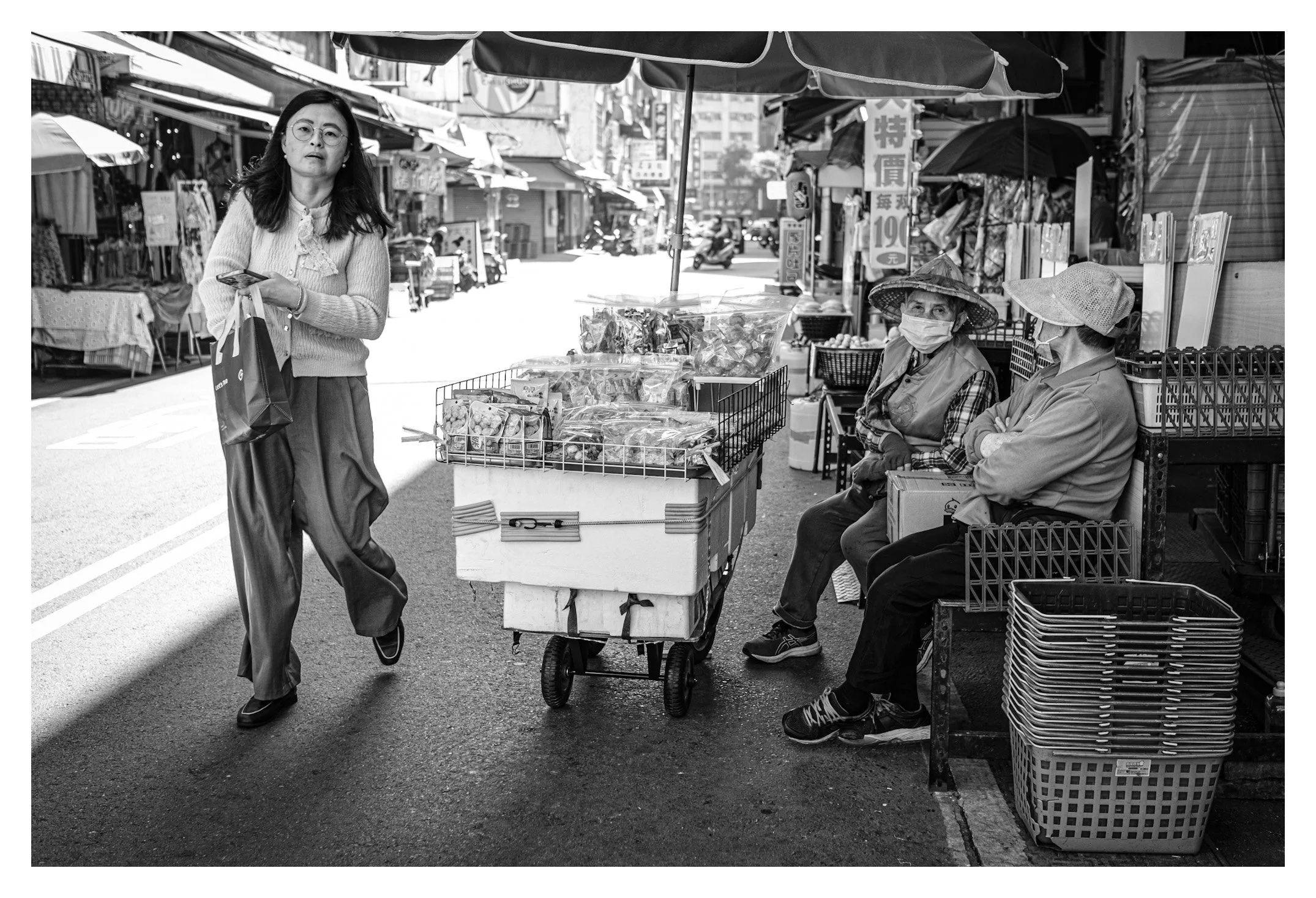
This image immediately strikes me as a study in separation. You have successfully utilized the harsh, directional sunlight—likely mid-morning given the angle—to create a stage where your actors play distinct roles. The high-contrast black and white processing is the correct choice here; color would likely have been a distraction amidst the visual noise of the product packaging and the busy background.
The composition operates on a "split stage" mechanic. On the left, we have motion and modernity—a younger woman striding forward, distracted by her phone, her shadow trailing like a ghost. On the right, we have stasis and tradition—the two older women seated, observing, anchored by the weight of their wares. The white cart in the center acts as a fulcrum, physically and visually separating these two worlds.
However, the image suffers slightly from a lack of connection. The central cart, while bright and textured, acts as a barrier rather than a bridge. It blocks the visual flow between the walker and the sitters. The energy of the walker is moving out of the frame rather than interacting with the scene. The "decisive moment" here feels slightly premature or perhaps a split-second too late; the tension hasn't quite peaked.
Improving the Image
To elevate this image from a "street record" to a "street narrative," I would have advised two different approaches:
1. Wait for the Intersection: Instead of capturing the subject walking away from the central action, wait for a moment where a subject interacts with the cart or looks toward the seated women. A glance, a transaction, or a gesture would bridge the gap between the left and right sides of the frame.
2. Change Your Position: You are shooting from eye level, which is safe but often detached. Crouching slightly lower would have elevated the walking figure, making her loom larger against the sky or the darker background, increasing her dramatic presence. Alternatively, moving two steps to the right would have compressed the gap between the walker and the sitters, making the scene feel more intimate and less like two separate photos stitched together.
The Data-Driven Photographer
You asked how to improve over time. The answer lies in treating your photography not just as art, but as data. You must become your own archivist.
I recommend creating a "shooting log" (a simple spreadsheet will do) that tracks more than just your EXIF data. For every successful image—and every failure—record the following:
• The Technical: Focal length, aperture, shutter speed (which you already know).
• The Environmental: Time of day, weather, quality of light (hard/soft).
• The Internal: How did you feel? Were you rushing? Were you stationary for 10 minutes? Were you nervous?
• The result: Why did it work? Why did it fail?
Over time, you will see patterns. You might discover that your best work happens between 4:00 PM and 5:00 PM, or that you consistently miss focus when you are feeling rushed. This self-awareness is the fastest route to mastery.
Recommendations for Study
To refine your understanding of high-contrast street photography and the "stage" of the street, I recommend the following resources.
Photographers to Research
• Fan Ho: A master of light and geometry. Study how he used shafts of light to simplify chaotic street scenes in Hong Kong. He would have loved the lighting in your image but would have waited for a more dramatic arrangement of figures.
• Chang Chao-Tang: Since you are in Taiwan, you must study Chang. His work embraces the surreal and the absurd aspects of Taiwanese street life. He often shoots with a sense of alienation that is present in your walking subject.
• Garry Winogrand: For understanding how to manage complex, multi-subject frames without losing the energy.
Books to Read
• "Portrait of Hong Kong" by Fan Ho: This is essential for understanding how to use backlighting and shadow to create drama in Asian street markets.
• "Moments in Time 1959-2013" by Chang Chao-Tang: This will ground your work in the local visual history of Taiwan.
• "Figments from the Real World" by Garry Winogrand: This will teach you about the "tilt" and how to stuff a frame with information while keeping it readable.
Videos to Watch
• Fan Ho - Master of Light and Shadow: A wonderful overview of how he constructed his images, often waiting for hours for the right actor to enter his stage.
• Composition with Garry Winogrand: This breakdown explains how Winogrand used form and content to create energy.
• Time: Looking Back at a Giant of Taiwanese Photography: A look at Chang Chao-Tang’s philosophy, which focuses on the "void" and the "absurd" in daily life.