

EXIF Data
Camera Model: Ricoh GRIII
Shutter Speed: 1/200 sec
Aperture: f/2.8
ISO: 200
The Critique
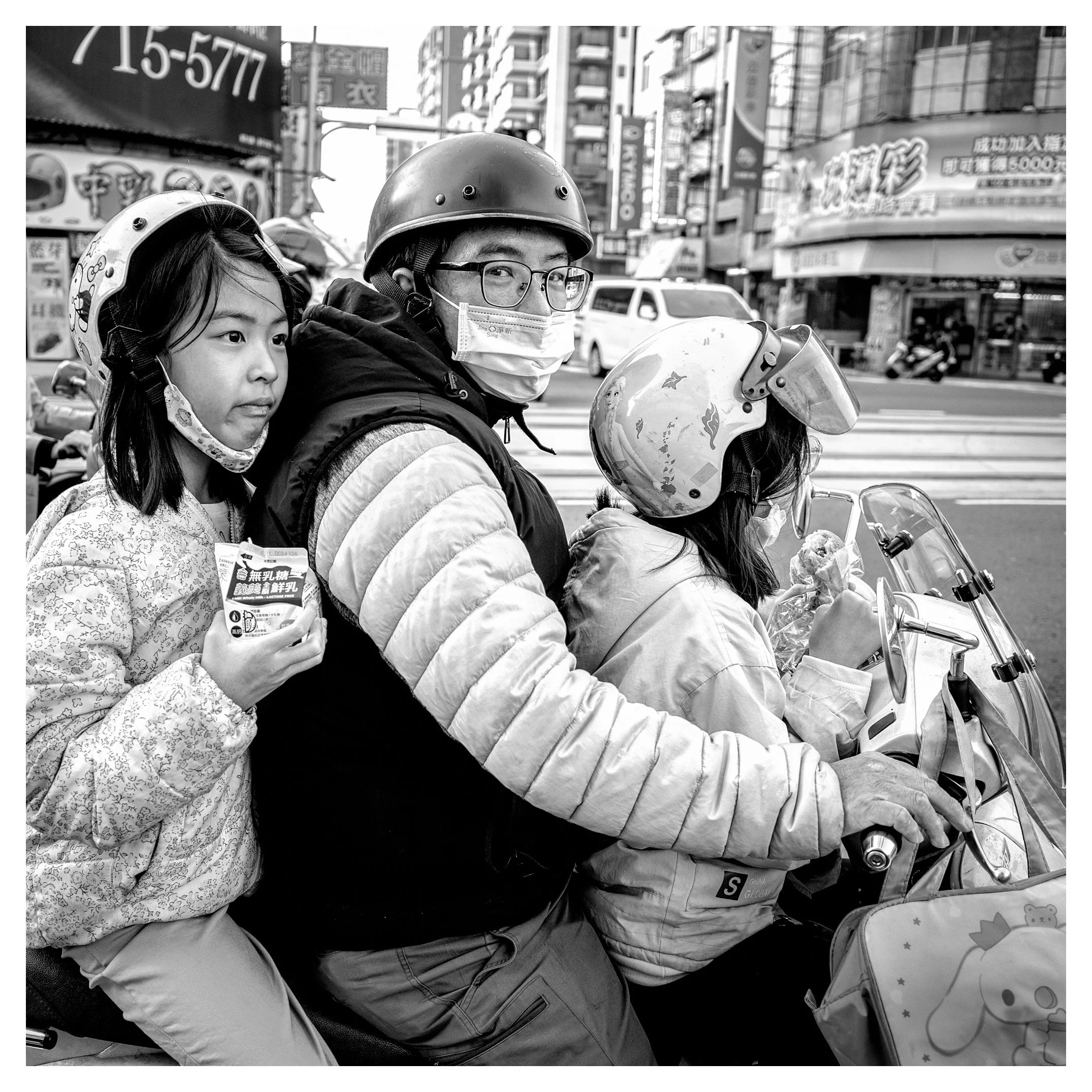
The scooter is the lifeblood of Taiwan; it is the family sedan, the delivery truck, and the solitary escape vehicle all at once. In this image, you have captured something more than just a mode of transport—you have captured a mobile domestic sphere.
The strength of this image lies in the "gaze." The driver (the father) locks eyes with your lens. It is not an angry stare, but a resigned, steady acknowledgment of your presence. This connects the viewer immediately to the subject. The composition is claustrophobic in the best possible way; the frame is packed with the textures of the city—the helmets, the jackets, the windshield, the signage in the background. It feels busy, just like a Kaohsiung intersection.
The black and white conversion is handled well. The Ricoh GRIII’s high-contrast monochrome signature works here to separate the subjects from the potentially distracting colors of the urban background. The tonal range on the father’s jacket and the younger child's helmet is particularly pleasing.
However, the framing feels slightly reactive rather than intentional. The elbows of the driver and the rear passenger are cut off abruptly at the edges. While street photography is often about the imperfect moment, a half-step back (or a slightly looser crop if this was cropped) would have given the subjects more "breathe" within the frame, emphasizing their unity against the chaotic backdrop rather than chopping into their silhouette.
Improving Your Craft
Immediate Adjustments
Next time you are in this situation, consider your depth of field. You shot this at f/2.8. While this provides good separation, street portraits with multiple layers of depth (the front child, the father, the rear child) risk having one subject slide out of focus. At f/2.8 on a wide lens like the GRIII, you are safe here because you are relatively close, but moving to f/4 or f/5.6 would ensure the child in the back remains as crisp as the father's glasses, without sacrificing too much light in daytime conditions.
Long-Term Growth: The "Missed Shot" Log
You asked how to compile data to improve. Most photographers only track their "keepers." To grow, you must track your failures.
I recommend creating a simple spreadsheet or a keyword system in Lightroom called the "Missed Shot Audit." Every time you reject a photo, tag it with the reason why:
• Missed Focus
• Motion Blur (Subject)
• Motion Blur (Camera Shake)
• Bad Composition (Cut off limbs)
• Too Late (Moment passed)
Review this data monthly. If you see 40% of your bad shots are "Motion Blur (Subject)," your default shutter speed of 1/200 is too slow for your style; move to 1/400. If 30% are "Missed Focus," stop relying on autofocus and start practicing "zone focusing" (pre-focusing to a set distance, like 1.5 meters, and shooting at f/8). This data-driven approach removes the mystery from your mistakes.
Recommendations for Study
To refine your eye for the "street portrait" and the chaos of urban life, I recommend the following resources.
Photographers to Research
• Chang Chien-Chi: A Magnum photographer born in Taiwan. His work on alienation and connection is unparalleled. Look at his book The Chain (often found in serious photobook collections) to see how he handles repetitive subjects with deep emotional weight.
• Shen Chao-Liang: Another Taiwanese master. While famous for his STAGE series, his ability to document the cultural landscape of Taiwan will help you see the "scooter chaos" as a cultural stage.
• Garry Winogrand: The grandfather of chaotic street photography. He shot seemingly messy frames that were actually organized by complex internal geometries. He would have loved the energy of a Taiwanese intersection.
Books to Read
• "The Chain" by Chang Chien-Chi: This will teach you about the power of the direct gaze and consistent framing.
• "Vivian Maier: Street Photographer": Maier was a master of the square format (which your image resembles) and the direct, unsmiling street portrait.
• "The Americans" by Robert Frank: Essential reading for understanding how to photograph a nation's people in transit.
Videos to Watch
• Shen Chao-Liang on his "STAGE" and "Drift" series: This video provides insight into how a Taiwanese photographer documents his own culture with a critical yet affectionate eye.
• Garry Winogrand - "I'm a Student of America": A fantastic look at how Winogrand operated on the street, moving constantly and embracing the energy of the crowd.
• Magnum Photos - The Art of Street Photography: A broader look at the philosophy that drives photographers like Chang Chien-Chi.