

EXIF Data
Camera Model: Fujifilm X-Pro2
Shutter Speed: 1/200
Aperture: f3.6
ISO: ISO200
The Critique
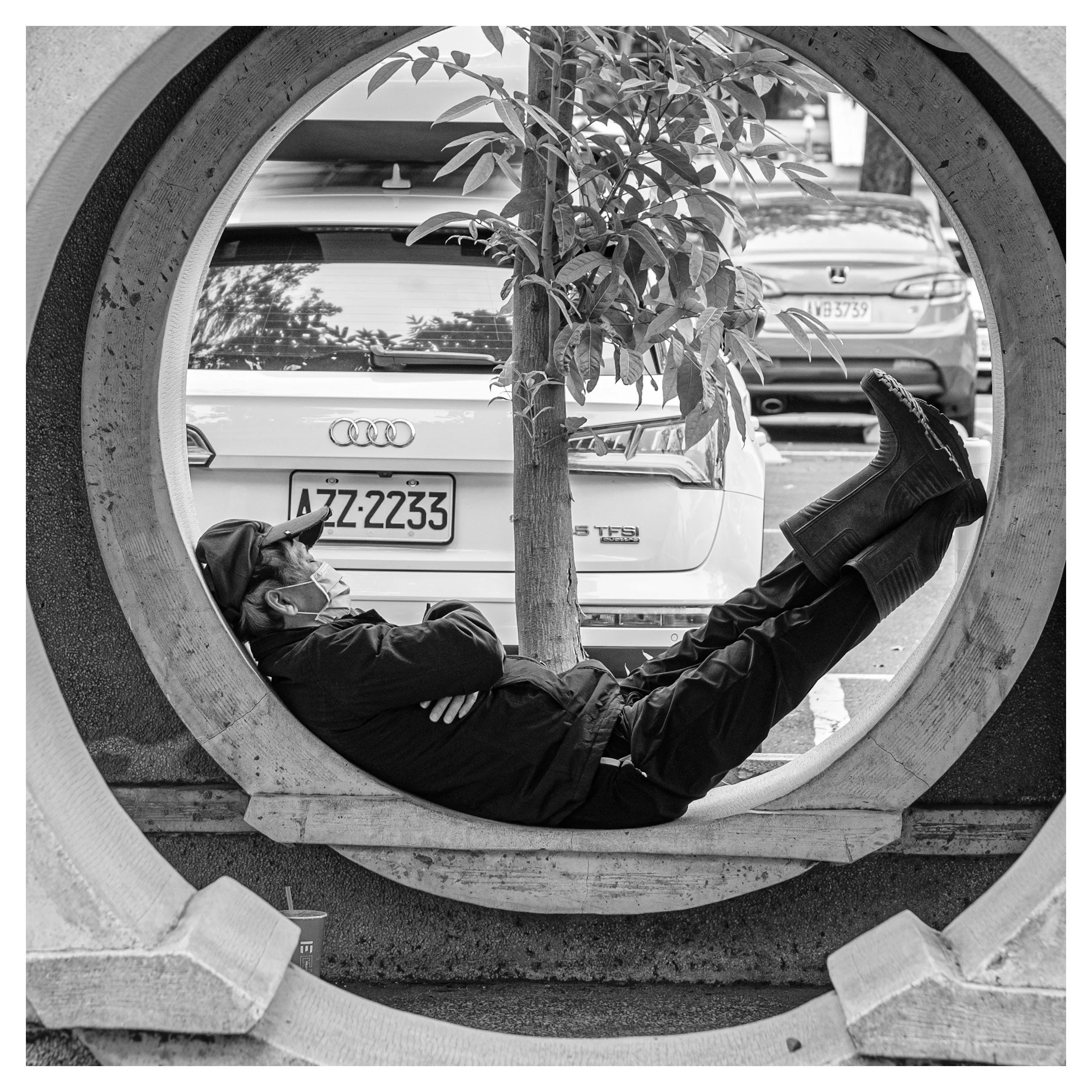
There is a wonderful, almost surreal dichotomy at play here. You have captured a moment of vulnerability—a man resting—encased within the brutalist rigidity of a concrete cylinder. This "frame within a frame" is a classic compositional device that immediately isolates your subject from the noise of the city, turning the pipe into a temporary sanctuary, or perhaps a modern, urban womb. The vertical line of the tree trunk bisecting the circle is a bold choice; it visually anchors the image but also disrupts the flow of the sleeper’s curved form.
However, the battle in this image is between the foreground and the background. The background is currently winning in a way you might not want. The sharpness of the white Audi (license plate AZZ-2233) and the clutter of the roof rack distract from the peacefulness of the sleeper. While the black and white conversion helps unify the tones, the depth of field is too deep, keeping the chaotic street details uncomfortably present.
Advice on Improvement
1. Isolate with Aperture
You shot this at f3.6, but your XF50mm lens opens up to f2. Shooting wide open at f2 would have significantly reduced the depth of field. This would render that distracting Audi into a soft wash of shapes, forcing the viewer's eye to stay strictly on the crisp textures of the concrete and the sleeping figure.
2. Subtract by Angle
Photography is often an art of subtraction. A slight shift in your position—perhaps moving a foot to the right or lowering your angle—might have allowed the concrete rim to physically block the car's license plate or the roof rack. Always check the corners and the background before you click; they are just as important as the subject.
Becoming a Better Photographer: The Data Approach
To grow over time, you must become a student of your own work. I recommend you start a "Keeper Spreadsheet."
Every month, review your photos and log the metadata of your top 5 "keepers" (the photos you are proudest of). Track the following:
• Focal Length: Are you always shooting at 50mm, or do you prefer 23mm?
• Aperture: Do your favorite shots happen at f2 or f8?
• Lighting: Was it golden hour, harsh noon, or overcast?
Over a year, you will see a pattern emerge. If 90% of your best shots are at f2, stop stopping down to f3.6 unnecessarily! This data removes the guesswork from your artistic growth.
Recommendations
To refine your eye, you must consume great work. Here is a curated list of study materials for you, drawing from masters of structure, surrealism, and the sleeping form.
Photographers to Research
• Fan Ho: He is the absolute master of using geometry and natural framing in an Asian context. Study how he uses shafts of light and architectural shapes to hide distracting backgrounds.
• Alec Soth: Since you have captured a sleeper, look at Soth’s work. He often captures subjects in states of vulnerability or rest, finding the poetry in the mundane.
• Chang Chao-Tang: As you are in Taiwan, you must study Chang. His work often leans into the absurd and the surreal, much like a man sleeping in a pipe in the middle of a city.
Books to Read
• "Moments in Time 1959-2013" by Chang Chao-Tang: This is essential for understanding the Taiwanese visual language, focusing on retrospective and surrealism.
• "Sleeping by the Mississippi" by Alec Soth: A masterpiece of dreaming, drifting, and the "poetry" of the unnoticed.
• "Think Like a Street Photographer" by Matt Stuart: This book is excellent for learning to spot candid, observational moments like the one you found here.
Videos to Watch
• Fan Ho | The Art of Light, Shadow, and Humanism: A beautiful look at how to simplify complex scenes.
• Alec Soth: Sleeping by the Mississippi: A deeper dive into the thought process behind his quiet, poetic images.
• Frame Within a Frame Photography: A quick, practical guide to mastering the composition technique you used in this image.