

EXIF data
Camera Model: Ricoh GRIII
Shutter Speed: 1/800
Aperture: f/3.5
ISO: 200
The Critique
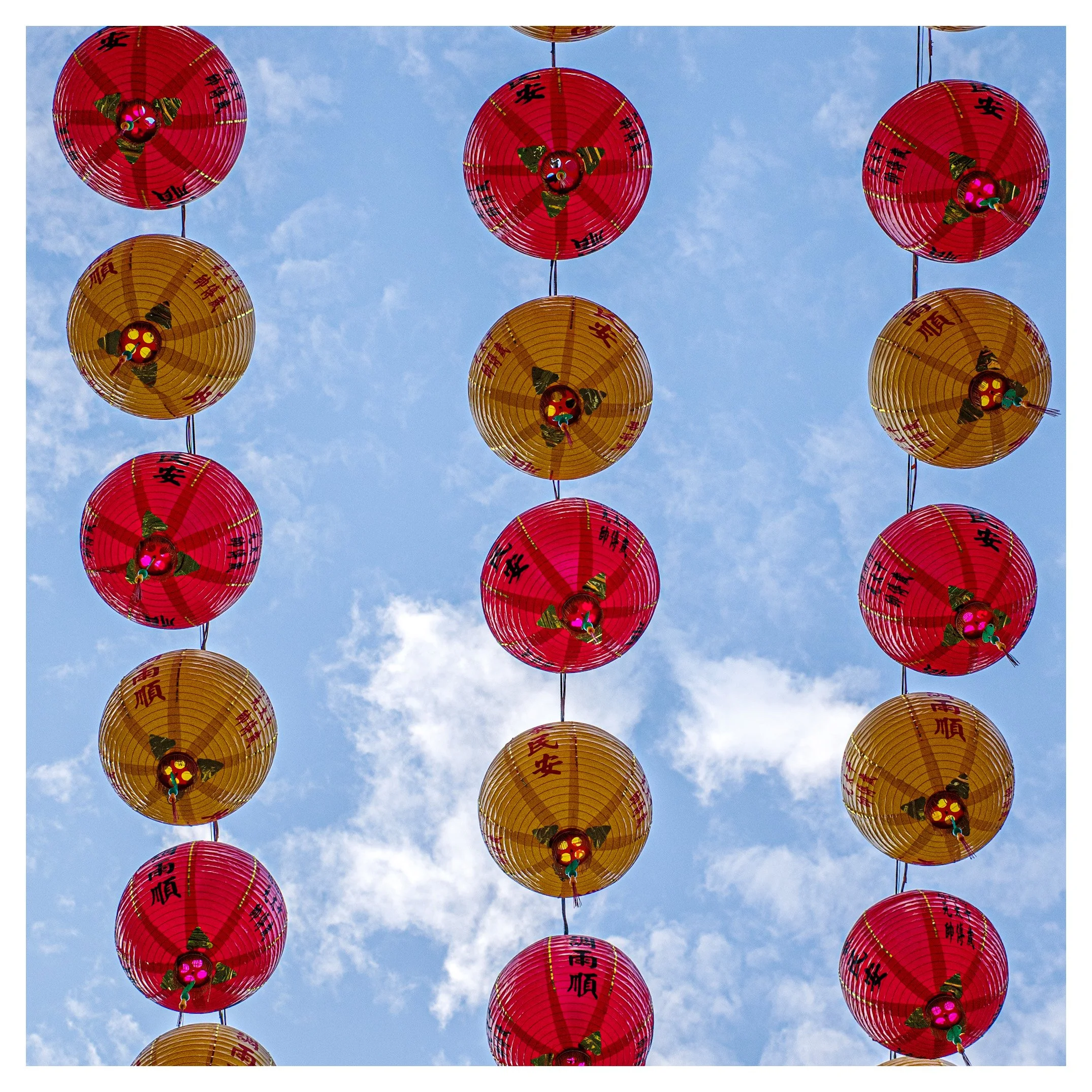
This image is a striking exercise in color theory and structural rhythm. You have captured a classic "primary triad" here—the vibrant red and warm yellow of the lanterns punching against the cool, azure canvas of the sky. This color contrast creates an immediate visual vibration that arrests the eye.
The composition relies heavily on repetition, utilizing the lanterns to create vertical columns that lead the viewer's gaze upward. This technique transforms individual objects into a unified graphic pattern, flattening the three-dimensional space into a beautiful, tapestry-like surface.
However, what truly makes this image "breathe" is the subtle variation. The lanterns are not perfectly aligned; they tilt and rotate slightly, revealing different angles of the text (likely "Peace" or "Safety"). These small deviations break the rigidity of the grid, introducing a human element to the geometry. The faint wisps of cloud in the background add a necessary softness, preventing the negative space from feeling sterile.
Technically, your shutter speed of 1/800 was a wise choice. It froze the motion of the lanterns, which were likely swaying in the wind, ensuring the text remained sharp. The aperture of f/3.5 on the Ricoh GRIII (a wide-angle 28mm equivalent) provides enough depth of field here because your subject distance is far enough away that infinity focus kicks in, keeping everything relatively sharp.
Improving the Image
To elevate this image from "graphic" to "masterpiece," consider the edges of your frame. In photography, the edges are just as important as the center.
• Crop Intentionality: The lantern at the very bottom center is cut off. In a pattern-based image, cutting a subject in half can sometimes feel accidental. I would advise either cropping tighter to make the pattern feel infinite (removing the edges entirely) or composing it so the bottom row is complete.
• Angle of View: You are shooting looking up, which is excellent for isolating the sky. Next time, try to position yourself so the lines of the wires create a pure diagonal or a perfect symmetrical center. A slight shift in your footing could align the wires to creating stronger "leading lines."
Becoming a Better Photographer: The Data Approach
You mentioned compiling data to improve. This is a brilliant, under-utilized strategy. Photography is often seen as purely intuitive, but analysis accelerates growth.
I recommend creating a "Personal Contact Sheet" system. Every month, review your top 10 and bottom 10 images. Log the following data points for them:
1. Focal Length: (Though fixed on the GRIII, this applies if you use crop modes).
2. Light Quality: (Hard sun, overcast, golden hour, artificial).
3. Subject Matter: (Static objects, people, nature).
4. The "Why": Write one sentence on why you took the shot.
Over six months, you will see a pattern. You might find that your best images are always shot in hard sunlight (high contrast), or that your "misses" usually happen when you try to shoot moving subjects at slow shutter speeds. This data allows you to double down on your natural strengths while purposefully practicing your weaknesses.
Recommendations for Study
To refine your eye for color and pattern, you must look outside of your current circle.
Photographers to Research
• Fan Ho: While famous for black and white, his mastery of geometric composition and the use of vertical lines is unparalleled. Study how he frames a scene to exclude clutter.
• Shen Chao-Liang: A Taiwanese master. Look at his STAGE series. He captures the chaotic, vibrant colors of Taiwan’s cabaret trucks with incredible precision. It will teach you how to manage "loud" colors like the ones in your lantern photo.
• Michael Wolf: Specifically his Tokyo Compression or Architecture of Density series. He fills the frame with repetitive structures (buildings, faces), creating a sense of overwhelming pattern that is strangely beautiful.
• William Eggleston: The father of color photography. Study how he uses the color red. He treats color as the subject itself, not just decoration.
Books to Read
• "The Nature of Photographs" by Stephen Shore: This is essential. Shore breaks down a photograph into the Physical, Depictive, and Mental levels. It will help you understand how an image translates reality into a flat piece of paper.
• "Interaction of Color" by Josef Albers: This is technically an art design book, but it is crucial for photographers. It demonstrates how colors change based on what they are next to (e.g., how that yellow lantern looks different against blue sky vs. a grey wall).
Videos to Watch
• Sean Tucker - "Protect your Highlights (and your shadows will look after themselves)": Sean is a philosopher-photographer. This video is excellent for understanding exposure, which is critical when shooting bright objects (lanterns) against bright skies.
• The Art of Photography (Ted Forbes) - "Composition in Photography": Ted breaks down the history of visual composition better than almost anyone on YouTube.
• Fan Ho - "The Art of Photography" Documentary excerpt: Seeing him discuss his patience in waiting for the perfect moment will inspire you to slow down with your GRIII.