

EXIF Data
Camera Model: Ricoh GRIII
Shutter Speed: 1/25
Aperture: f/2.8
ISO: 500
The Critique: Beauty in the Banal
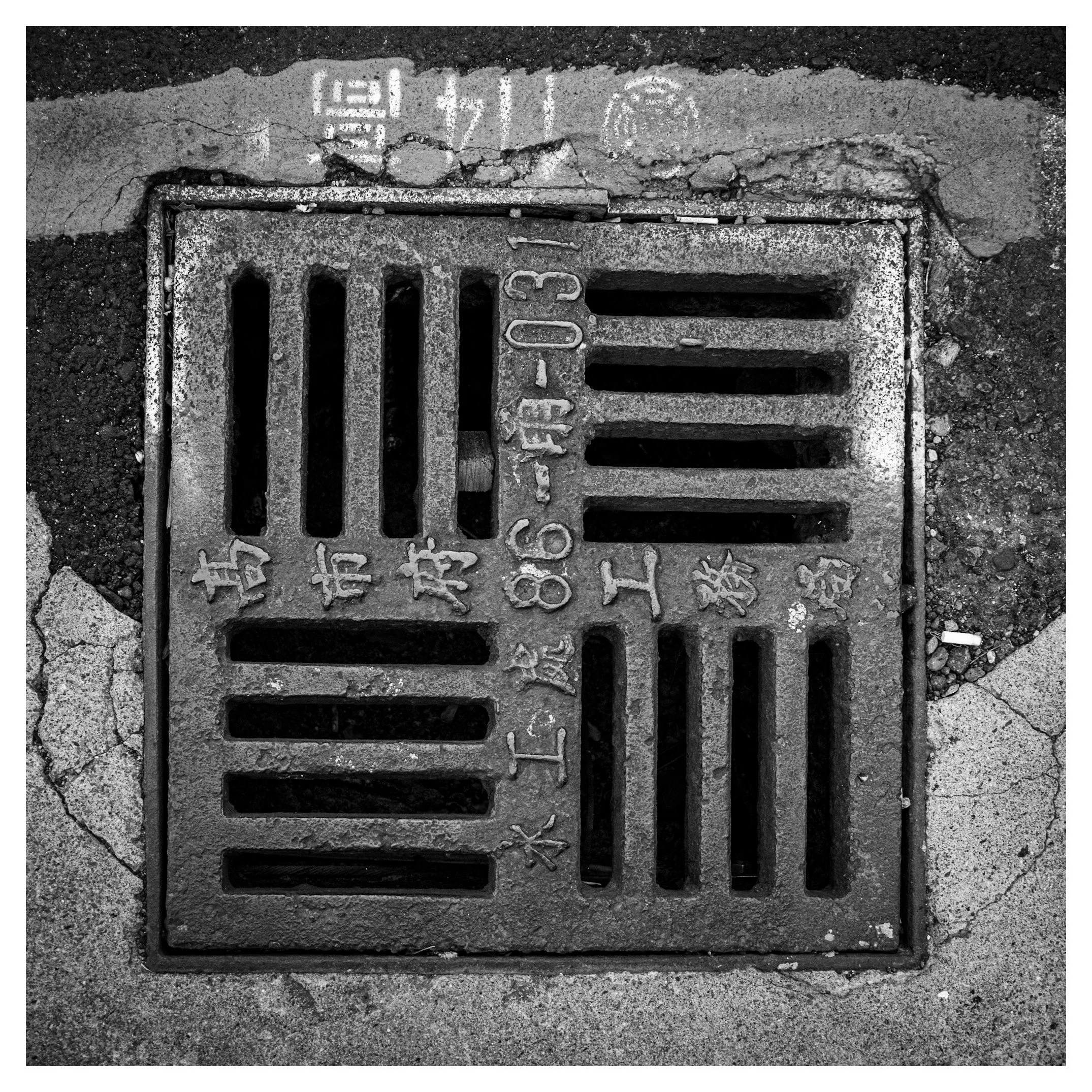
There is a quiet confidence in this image. It is a "deadpan" photograph—a frontal, unblinking look at an object usually ignored by the passing crowds. You have chosen a subject that is purely functional, a drain grate in Taiwan (identifiable by the "Kaohsiung City Government" characters: 高市府工務局), and elevated it through strict framing.
The strength here lies in the geometry. The square format of the Ricoh GRIII's sensor (or your crop) mirrors the square metal plate, creating a satisfying frame-within-a-frame. The vertical slots contrast beautifully with the horizontal Chinese characters, creating a grid-like abstraction reminiscent of the paintings of Piet Mondrian, if Mondrian worked in asphalt and iron.
However, the image feels slightly suffocated. The crop is incredibly tight, cutting off the context of the street completely. While this forces us to look at the texture, it also removes the "sense of place." We know this is Taiwan because of the text, but we don't feel the street.
Technical Advice:
You shot this at 1/25th of a second. Even with the Ricoh’s Image Stabilization (IBIS), this is risky for a handheld shot looking down. You are lucky here that the subject is static, but for future reference, I would bump your ISO to 800 or 1600 to get that shutter speed up to 1/125. The Ricoh GRIII handles noise beautifully; don't be afraid of a little grain—it often adds soul to street textures.
Becoming a Better Photographer: The Photographic Ledger
I noticed you already maintain a database of your photography books (an impressive collection, by the way). You should apply this same rigor to your own images.
To improve over time, you must treat your photography like a science experiment. Start a "Shooting Log" (a simple spreadsheet will do) with the following columns:
1. Date/Location
2. Technical Settings (Shutter, Aperture, ISO)
3. The "Why" (What caught your eye? Texture? Light? Irony?)
4. The Result (Did it work? Why or why not?)
Reviewing this data after 6 months reveals patterns. You might realize, "I consistently shoot too slow," or "I only take good photos when I am angry," or "I am obsessed with the color red." This self-awareness is how you develop a style.
Recommendations
To push this "texture and geometry" style further, I want you to look at photographers who mastered the art of the mundane.
1. Daido Moriyama
Your library already includes Daido Moriyama and Farewell Photography, so you clearly appreciate the gritty, high-contrast aesthetic. Moriyama often shoots the ground, stray dogs, and textures of the city. He teaches us that a photo doesn't need to be "clean" to be powerful.
• Watch: Daido Moriyama: The Photographer Who Didn't Look Through the Viewfinder
2. Walker Evans
Evans was the master of the "vernacular"—the common language of architecture and signs. He would have loved this drain cover. He photographed shop windows, tools, and signs with the same respect usually reserved for religious icons.
• Watch: The Most Influential American Photographer EVER // Walker Evans
3. Fan Ho
You own Portrait of Hong Kong, which is a masterpiece. While Fan Ho is famous for his lighting, look closely at his use of geometry and framing. He often used the lines of the street to slice the frame, much like the bars on your drain cover.