

Day 83/365 The Banyan Effect: Capturing Flow in Static Architecture
EXIF Data
Camera Model: Ricoh GRIII
Shutter Speed: 1/60
Aperture: f2.8
ISO: 2500
The Critique
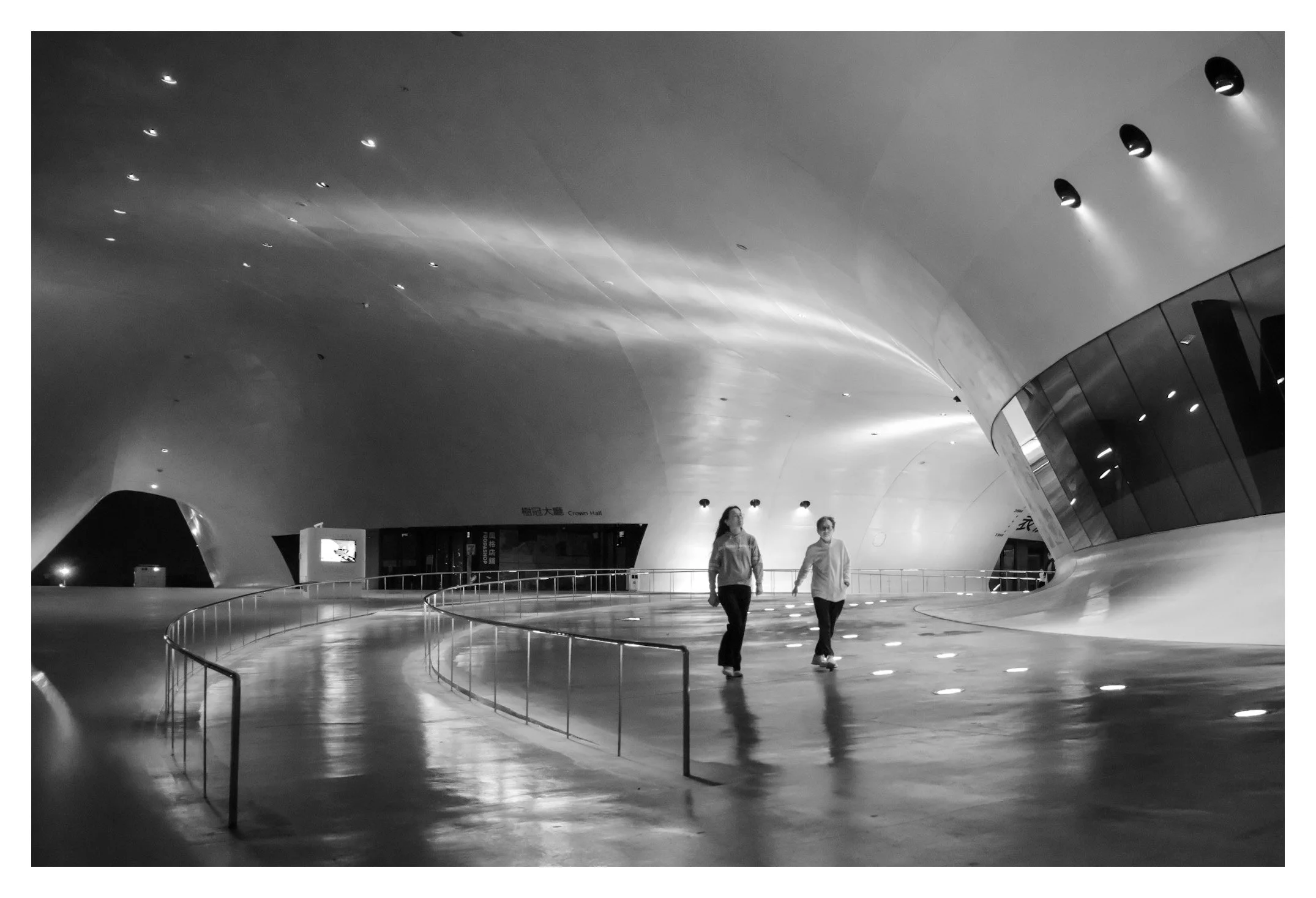
My apologies. Of course, this is the unmistakable Banyan Plaza of Weiwuying (National Kaohsiung Center for the Arts). Where Toyo Ito’s Taichung Theater feels like a cave, Mecanoo’s Weiwuying feels like a canopy. The distinction is vital because the flow of energy here is open-ended, allowing wind and people to move freely, much like the aerial roots of the banyan trees that inspired it.
Your image captures that fluidity well. The monochromatic treatment emphasizes the sweeping curves of the ceiling, turning the architecture into a gradient of grays rather than a structure of steel and concrete. The Ricoh GRIII, with its heritage of high-contrast street photography, renders the scene with a gritty texture at ISO 2500 that works in your favor here—it adds "tooth" to the smoothness of the floor.
However, the composition feels slightly hesitant. You have captured the space, but the subjects feel small against the vastness of the "trunk" on the right. In a space this large, you must decide: is the photo about the architecture, or is it about the people? If it is the architecture, the people are distractions. If it is the people, they need to anchor the frame more firmly.
Advice for Improvement
1. The "Fishing" Technique
In a space with such predictable foot traffic as Weiwuying, do not chase your subjects. Pick a composition where the architectural lines converge—perhaps near one of the floor lights—and lock your focus there. Wait for a subject to enter that specific trap. This allows you to compose the background perfectly before the human element arrives.
2. Shutter Speed Safety
Weiwuying is darker than it looks to the human eye. 1/60 is the absolute floor for handheld photography with moving subjects. To get the figures tack sharp, especially walking, push your ISO to 3200 or 6400 and get that shutter to 1/125 or 1/250. The Ricoh GR tends to handle luminance noise beautifully in Black and White; embrace the grain to ensure sharpness.
3. Compiling Data for Growth
You asked how to use data to improve. You should start a "Metadata Journal" (a simple spreadsheet) where you log your favorite 5 and least favorite 5 images each month.
• Column A (Focal Length): Are you always cropping your 28mm shots? If 90% of your keepers are cropped, you are standing too far away. Step closer.
• Column B (Shutter Speed): Filter your "rejects" by blur. If most blurry shots are at 1/60, you now have empirical proof that your hand-holding limit or subject motion requires 1/125.
• Column C (ISO): Many photographers fear high ISO. If you review your top-rated images and find they are often ISO 1600-3200, you will stop being afraid of the dark and start shooting more freely.
Recommendations
To deepen your understanding of high-contrast monochrome work and photography in Taiwan, I recommend the following resources found in your database.
Photographers to Research
• Chang Chao-Tang: Since you are in Taiwan, you must study the master of Taiwanese surrealism. His work often involves absurdity and high contrast, perfect for the unusual shapes of Weiwuying.
• Daido Moriyama: As a Ricoh GR shooter, Moriyama is your spiritual ancestor. He shoots high-contrast, grainy, blurry black and white, often treating the city as a raw organism.
• Jason Eskenazi: His work captures people moving through history and space with a cinematic, almost fairy-tale quality that suits grand architecture.
Books to Read
• "Moments in Time 1959-2013" by Chang Chao-Tang
• Why: A retrospective that covers environmental portraiture and absurdity, offering a local context to your street photography.
• "Wonderland: A Fairy Tale of the Soviet Monolith" by Jason Eskenazi
• Why: This book teaches you how to compose human figures within massive, sometimes overwhelming societal and architectural structures.
• "Minutes to Midnight" by Trent Parke
• Why: Parke uses light to obliterate detail and create atmosphere. It is essential study for making high-ISO files look artistic rather than messy.
• "The Decisive Moment" by Henri Cartier-Bresson
• Why: Essential for understanding the geometry of waiting for a subject to complete a composition.
Videos to Watch
• Daido Moriyama - "The Past is Always New"
• Why: Watch how he moves—like a stray dog. He doesn't overthink; he reacts. This will help you use the Ricoh GRIII more instinctively.
• Chang Chao-Tang: The Absurdity of Existence
• Why: Understanding the "Theatre of the Absurd" in a Taiwanese context will help you see places like Weiwuying not just as buildings, but as stages.