

EXIF Data
Camera Model: Ricoh GRIII
Shutter Speed: 1/100
Aperture: f/3.2
ISO: 320
The Critique
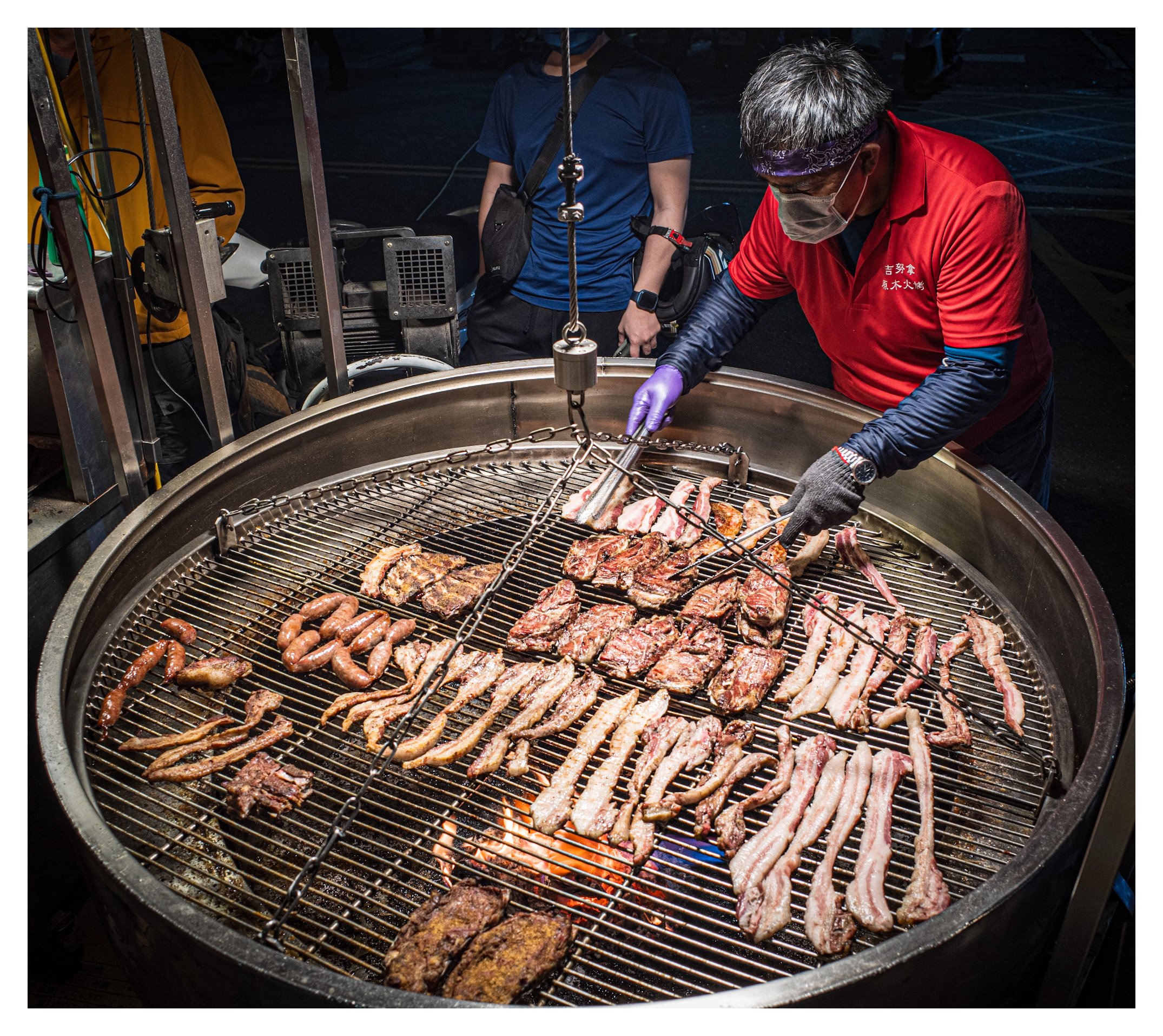
There is a satisfying, almost hypnotic gravity to this image. You have anchored the frame on the geometry of the grill—a literal circle of heat that organizes the chaos of the Kaohsiung night market into a coherent stage. The choice of the Ricoh GRIII, a 28mm equivalent, forces you into the fray, and the perspective here feels intimate, hovering just over the shoulder of the action.
The strength of this photograph lies in its textures and color palette. The interplay between the metallic sheen of the grill and the visceral, warm reds of the curing meat creates a tactile quality; one can almost smell the charcoal and fat. The chef, clad in a red polo that echoes the raw meat, becomes an extension of the machine he operates. His purple gloves offer a synthetic, cool-toned counterpoint to the overwhelming warmth of the frame, a subtle punctum that draws the eye to the hands—the point of creation.
However, the image remains largely documentary. It records the process faithfully but stops short of interpreting it. The background figures are cut off, present but not participating in the narrative. To elevate this from "travel documentation" to "fine art," we need to push past the obvious subject (the meat) and find the psychological tension in the scene.
Improving the Image
Technical Adjustments:
At 1/100s, you have frozen the action safely. However, in a scene defined by heat and smoke, a slightly slower shutter speed (perhaps 1/30s or 1/50s) could have introduced a slight motion blur to the chef’s hands or the rising smoke, breathing life and movement into the static circle.
Compositional Shift:
You are shooting slightly from above, a "safe" observer's angle. To increase the drama, get lower. Align the lens with the surface of the grill. This would compress the foreground meat against the background chef, making the grill appear vast and monumental. Alternatively, step back to include the faces of the waiting customers—their anticipation provides the emotional context that the meat alone cannot supply.
Becoming a Better Photographer Through Data
You cannot improve what you do not measure. To evolve, you must treat your photography library as a dataset.
1. The "Keeper" Audit:
Every month, tag your top 5 images. At the end of the year, filter for these tags and look at the metadata. You might discover that 80% of your best shots were taken at ISO 800+, or that you consistently favor f/2.8. If you find you are shooting wide open (f/2.8) even in bright light, you are likely relying too heavily on bokeh to separate your subjects rather than using composition.
2. The Focal Length Challenge:
The Ricoh is a fixed focal length, which is a disciplined teacher. However, analyze your crop factor. Are you consistently cropping your 28mm images to look like 50mm? If so, you are standing too far away. The data will tell you if you are afraid of getting close.
3. ISO Tolerance:
Test your camera's limits. Shoot the same night scene at ISO 1600, 3200, and 6400. Print them small. You will likely find that your fear of "noise" is unfounded and that a grainy, sharp image is infinitely better than a clean, blurry one.
Recommended Study Material
To bridge the gap between documentation and art, you must study those who have turned the chaotic street into a stage. Based on your current trajectory, I have selected the following resources for you.
Photographers to Research:
• Shen Chao-Liang (The "STAGE" Series): Since you are shooting in Taiwan, Shen is essential. His work documenting stage trucks is a masterclass in how to capture the surreal, neon-soaked reality of Taiwanese nightlife without it feeling like a tourist snapshot. He treats these cultural artifacts as monuments.
• Martin Parr: Parr is the king of consumption. He photographs food not to make it look delicious, but to make it look strange, colorful, and revealing about the culture eating it. Look at how he uses flash to flatten the image and saturate the colors—something your Ricoh is very good at.
• Alex Webb: For managing complex frames. Webb would have waited for a customer's face to appear in the gap between the chef's arm and the grill, adding a layer of narrative complexity.
Books to Read:
(I have selected these from your database as they are particularly relevant to your growth)
• STAGE by Shen Chao-Liang: Study this for color and cultural context.
• The Suffering of Light by Alex Webb: A bible for understanding how to organize chaotic streets into complex frames.
• Common Sense by Martin Parr: Study this for his unapologetic use of color and close-ups of food/consumption.
Videos to Watch:
• Shen Chao-Liang on his "STAGE" series: This will help you see the "performance" aspect of the night markets you are shooting.
• Alex Webb on "The Suffering of Light": Listen to him discuss how he layers images. Pay attention to his philosophy on "waiting" for the image.
• Martin Parr on Food Photography: A brilliant, short insight into why he photographs food and how he breaks the rules of "polite" photography.