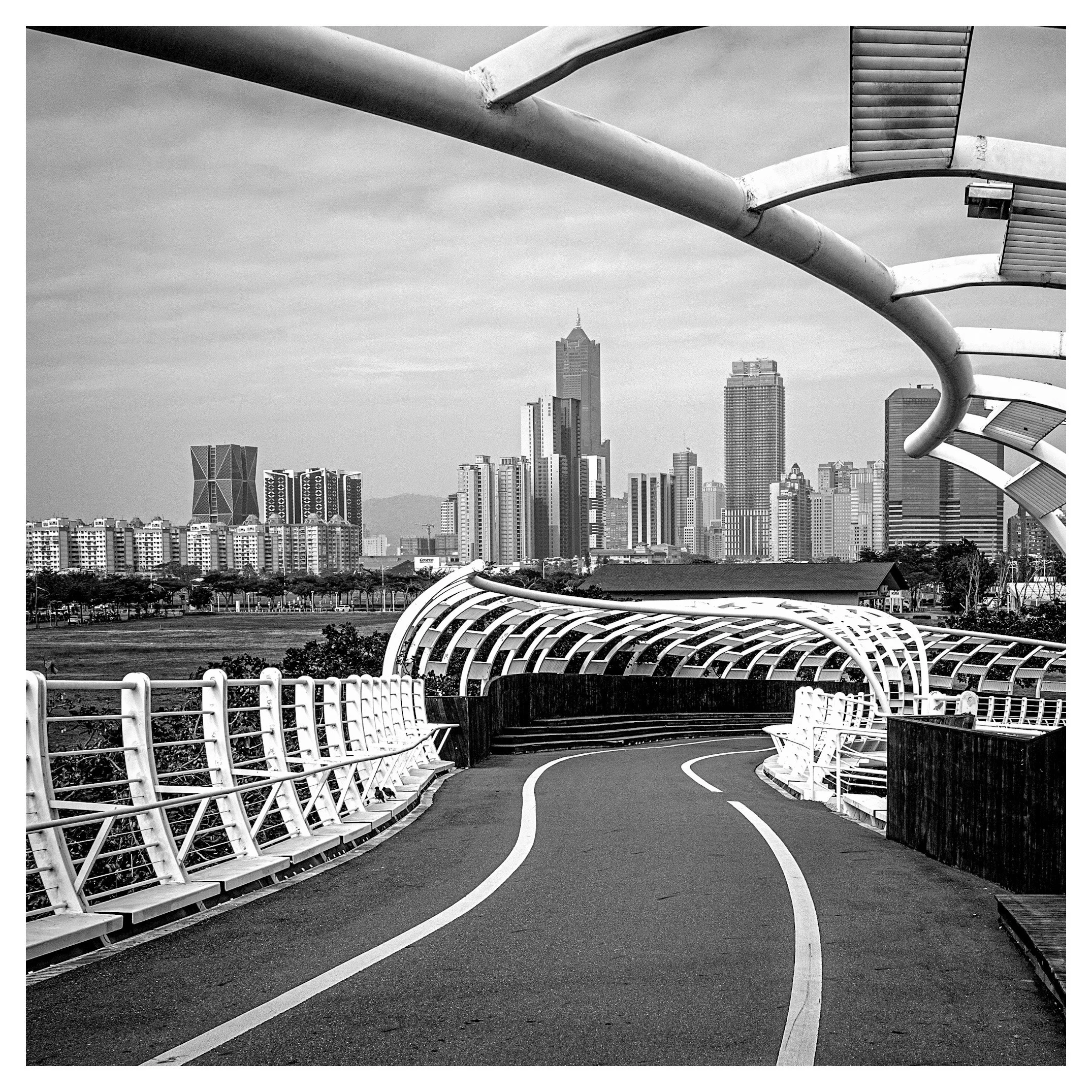
Day 87/365 The Curvature of Concrete: Finding Flow in Kaohsiung
EXIF Data
Ricoh GRIII, 1/1600, f5, 200ISO
The Critique
This is a study in juxtapositions, a favorite theme of mine. You have captured a striking dialogue between the foreground and the background—the "Star of Qianzhen" bike bridge acting as a skeletal, organic ribcage that breathes life into the rigid, brutalist spine of the 85 Sky Tower in the distance. The choice of black and white is astute here; it strips away the distraction of color, forcing the viewer to focus entirely on the geometry and the interplay of light and shadow.
The leading lines are technically sound. The white curve of the path grabs the eye immediately, pulling us through the frame and depositing us right at the foot of the city's vertical giants. The texture of the asphalt against the smooth metal of the bridge creates a tactile quality that is quite pleasing.
However, the image feels somewhat "empty." It is a stage set waiting for an actor. The scene is immaculate, perhaps too much so. It lacks the pulse of the city. We have the structure of urban life, but not the life itself. The sky, while textured, feels a bit heavy in the mid-tones, pressing down on the city rather than opening up above it.
How to Improve
• The Decisive Moment: You are currently shooting architecture, but with a Ricoh GRIII, you are holding a street photographer's weapon. Next time, wait. Compose this exact frame and wait for a cyclist to bank around that curve, or a pedestrian to walk into the mid-ground. A human figure would provide immediate scale and a narrative anchor, turning a "nice photo of a bridge" into a story about living in Kaohsiung.
• Post-Processing the Sky: In black and white photography, the separation between sky and building is critical. A slight "dodge" (lightening) of the highlights on the bridge railing would make it pop more against the darker grass, and a "burn" (darkening) of the upper sky might create a more dramatic gradient, drawing the eye down to the city.
Becoming a Better Photographer: The Data Approach
To evolve, you must understand your own subconscious habits. I want you to start compiling a simple dataset of your best images:
1. Focal Length: (Though fixed on the GRIII, note your crop modes).
2. Time of Day: Are you always shooting at high noon (hard shadows)?
3. Subject distance: How close are you to your subject?
Reviewing this data after 6 months will reveal your "comfort zone." If 90% of your shots are mid-day architecture from a distance, force yourself to shoot close-ups at dusk for a month. Discomfort breeds growth.
Recommendations for Study
To refine your eye for urban geometry and black & white composition, I recommend the following:
Photographers to Research:
• Fan Ho: For his mastery of light, shadow, and geometric framing within an Asian urban context. He made Hong Kong look like a theater stage; you can do the same for Kaohsiung.
• Ezra Stoller: The master of architectural photography. Study how he uses lines to explain the function of a building.
• Chien-Chi Chang: A Magnum photographer from Taiwan. His work The Chain is haunting, but look at his broader body of work for a masterclass in composition and social context.
Books to Read:
• The Decisive Moment by Henri Cartier-Bresson (Essential for understanding when to click the shutter).
• Fan Ho: Portrait of Hong Kong by Fan Ho (Study his use of leading lines).
• Tokyo Compression by Michael Wolf (For a different, more claustrophobic take on urban density).
Videos to Watch:
• The Narrative Photography of Fan Ho – A beautiful breakdown of how he used geometry to tell stories.
• Understanding Leading Lines – A great refresher on how to use lines not just to point, but to isolate subjects.
• Ezra Stoller: Beyond Architecture – Understanding how to "read" a building before you shoot it.