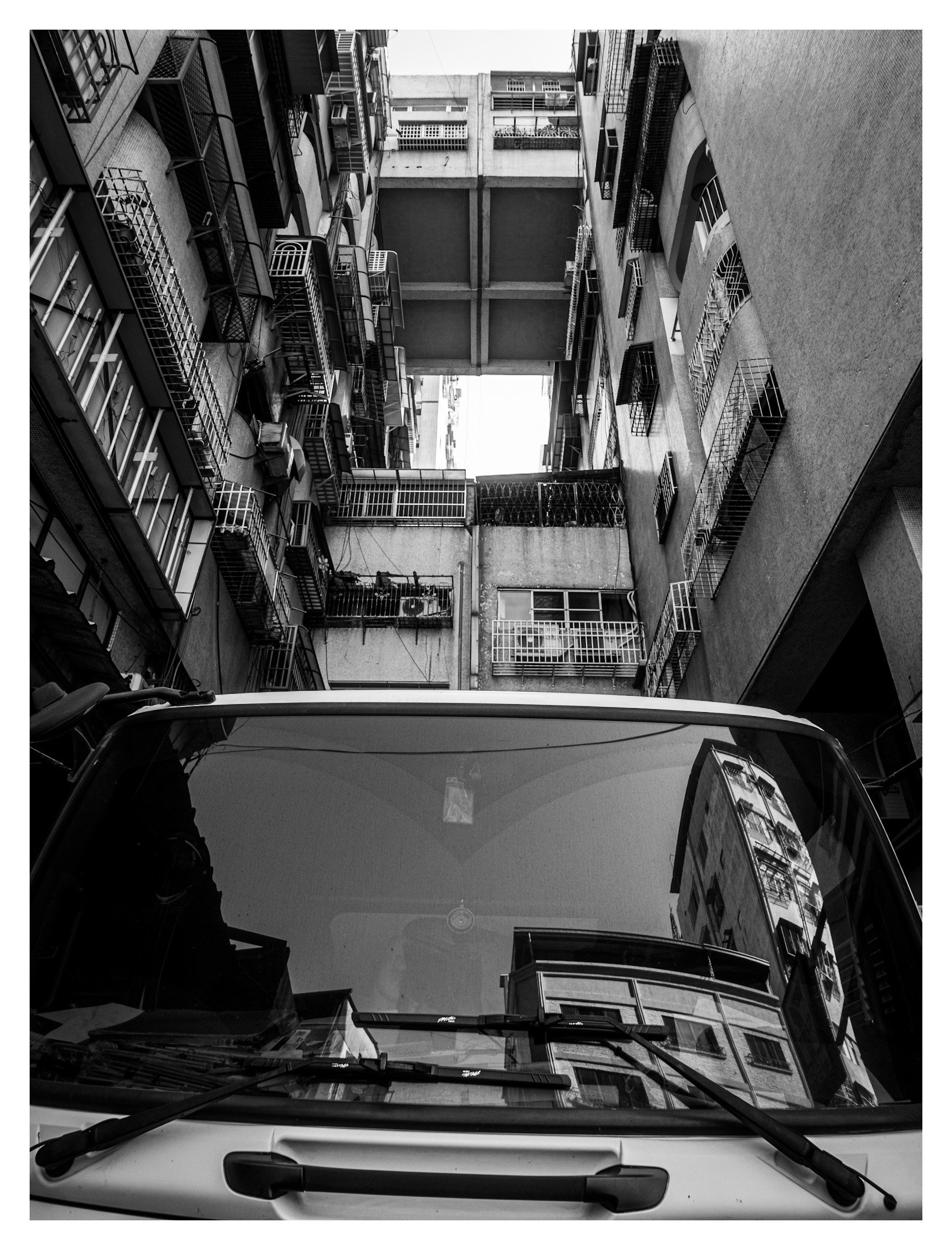
Day 93/365 Vertical Vertigo: Finding Poetry in the Concrete Canyon
EXIF Data
Camera Model: Leica D-Lux8
Shutter Speed: 1/125
Aperture: f/4
ISO: 200
The Critique
This is a photograph that understands the weight of its subject. You have captured the distinct, suffocating density that defines the Asian metropolis—likely a "tong lau" or older apartment block in Taiwan. The choice of vertical orientation is excellent; it exaggerates the height and imposes that feeling of being small in a canyon of concrete.
The composition relies on a "frame within a frame" structure, with the skybridge acting as a lintel connecting the two masses. The reflection in the vehicle’s windshield at the bottom is a sophisticated touch—it grounds the image and doubles the texture, creating a totem pole of grit.
However, the image sits on a knife's edge between "gritty documentary" and "underexposed." The shadows in the recessed balconies are swallowing detail that might add narrative depth. While the high contrast works for the mood, the sky at the top is nearing a "blown out" white which distracts the eye.
How to improve this specific image:
• Dodge and Burn: In post-processing, gently lift the exposure on the central skybridge to make it a stronger focal point. Conversely, burn (darken) the bright sky patch at the very top to keep the viewer's eye inside the frame.
• The Anchor: The white vehicle hood is very bright. Crop slightly upwards to remove the wiper blades, or darken the hood so the reflection remains but the hardware of the car doesn't compete with the architecture.
Developing Your Eye: The Data Approach
You asked how to use data to improve. Photography is often seen as purely emotional, but the technical data (metadata) is a goldmine for self-discovery.
The "Metadata Audit" Method:
1. Quarterly Review: Once every three months, open your catalog (Lightroom, Capture One, etc.) and filter for your 5-star "Keeper" images only.
2. Analyze the Stats: Look at the distribution of your focal lengths and apertures on these winners.
• Example: You might think you are a wide-angle street photographer (24mm), but your data might reveal that your best shots are actually taken at 50mm or 75mm.
• Action: If 80% of your best shots are at f/4 (like this one) and f/5.6, stop worrying about buying expensive f/1.4 lenses. Lean into the deep depth of field that is clearly working for you.
3. The "Trash" Audit: Do the same for your 1-star rejected photos. Is there a pattern? Are they all motion-blurred? If so, your "minimum shutter speed" setting needs to be raised.
Recommendations for Study
To refine this gritty, architectural aesthetic, you need to study photographers who turned "density" into "design."
Photographers to Research:
• Michael Wolf: Since you are shooting vertical density, Wolf is the master. Look past Tokyo Compression and study his Architecture of Density series. He removes the sky and ground to create infinite patterns.
• Ray K. Metzker: For his use of high contrast and "composites." He often shot urban environments in deep shadow where the darkness was a physical shape, not just an absence of light.
• Chien-Chi Chang: As a Magnum photographer born in Taiwan, his work The Chain is iconic, but look at his Jet Lag series for how he handles alienation in urban spaces.
Books to Read:
• "The Nature of Photographs" by Stephen Shore: This is less about "street" and more about understanding the physical structure of a photograph—the "depictive level" vs. the "mental level." It will help you understand why your reflection shot works.
• "Daido Moriyama: Farewell Photography": If you want to push your gritty B&W aesthetic further, this is the manifesto of the "Are, Bure, Boke" (grainy, blurry, out-of-focus) style.
Video to Watch:
I’ve selected a video on Fan Ho. While his work is often associated with the 1950s Hong Kong light and shadow, his philosophy on "The Decisive Moment" and cropping is timeless. He often cropped his squares heavily to create verticals, much like your image.
The Narrative Photography of Fan Ho
I chose this video because Fan Ho masters the art of using urban geometry to frame a narrative, similar to how you used the apartment block to frame the sky.